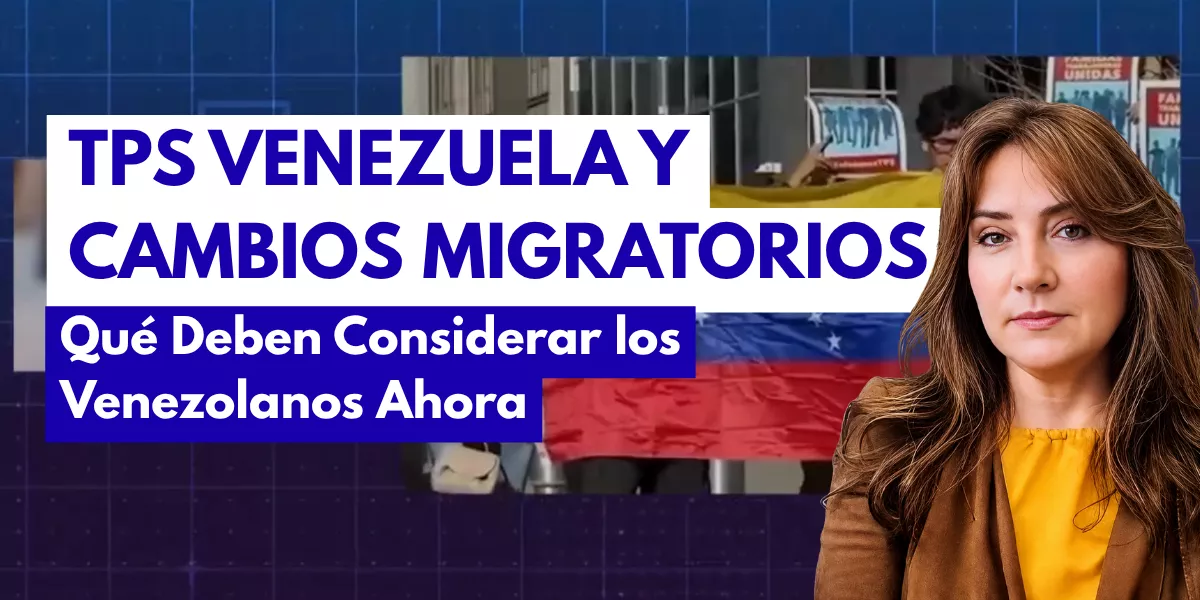
Venezuela TPS: What the October 30 Court Decision Means for November 6

On Friday, October 30, I joined journalist José Pernalete on VPItv‘s Esto es América to discuss an important federal court decision affecting Venezuelans who previously held Temporary Protected Status (TPS).
The U.S. Court of Appeals for the Ninth Circuit denied the federal government’s request to keep a lower-court order suspended after the expiration of an existing Supreme Court stay.
This development creates the possibility that TPS protections for affected Venezuelans could be restored beginning November 6, 2026. However, this is not yet a final resolution of the legal dispute.
What Did the Court Decide?
In National TPS Alliance v. Mullin, the Ninth Circuit rejected the government’s October 2026 request for another stay pending appeal. The court also denied a request for an additional administrative stay.
The Supreme Court’s existing stay is scheduled to expire on November 6. Unless further court intervention changes the situation, the underlying order could once again take effect.
Importantly, the litigation continues. The October 30 decision does not permanently resolve Venezuela’s TPS designation.
What Does This Mean for Venezuelan TPS Holders?
During my conversation with José Pernalete, I emphasized that we must distinguish between a favorable court development and a final immigration benefit.
A person’s situation may depend on several factors, including whether they were covered under the 2021 or 2023 Venezuela TPS designation, their registration history, employment authorization, and any other immigration proceedings.
For individuals currently in removal proceedings, the situation may be more complicated. Questions involving administrative closure, termination of proceedings, asylum applications, and other potential relief must be reviewed individually.
My recommendation is not to assume that TPS has already been restored or that an existing immigration problem has automatically been resolved.
Continue monitoring official developments, keep your immigration documentation organized, and seek legal advice concerning your particular circumstances.
A Potential Relief, but Not Yet a Permanent Resolution
As I explained during the interview, the possibility of reinstating TPS is meaningful for many Venezuelan families. Nevertheless, the litigation remains ongoing, and further court action could change what happens next.
I appreciate José Pernalete and the VPItv team for providing an opportunity to explain this developing situation and the questions that Venezuelan families are facing.
LEGAL DISCLAIMER: This article provides general information about developments in U.S. immigration law and is not individualized legal advice. Court rulings and government guidance may change. Each person’s immigration circumstances must be evaluated separately.

Martha L. Arias, Esq.
Immigration Law Attorney
If you have questions about TPS or information about other immigration matters, call my office in Miami. Arias Villa, PLLC assists businesses, individuals and families with U.S. immigration matters.
Spanish Transcript:
JOSÉ PERNALETE (VPItv):
Continuamos. Esto es América. Presentamos a nuestra invitada. Cambiamos el esquema del programa en el día de hoy ante esta noticia que acaba de darse a conocer durante los recientes minutos.
Se conecta con nosotros Martha Arias. Ella es abogada, experta en inmigración, especializada en inmigración, y es precisamente en relación, abogada, con esta decisión anunciada por parte del Tribunal de Apelaciones del Noveno Circuito de Estados Unidos, que ha rechazado este viernes 30 de octubre la solicitud del gobierno del presidente Donald Trump para mantener suspendida una orden judicial que declaró ilegales las medidas adoptadas para retirar el TPS a favor de los venezolanos.
¿De qué se trata esta medida? ¿Cómo se cristaliza para la comunidad venezolana?
ABOGADA MARTHA ARIAS:
Bueno, sí, un saludo para ustedes, señor Pernalete, y toda su audiencia.
Efectivamente, el día de hoy, 30 de octubre de 2026, en el caso que se llama National TPS Alliance v. Mullin, la Corte de Apelaciones del Noveno Circuito, que ya sabemos está en California, determinó que, este, o sea, la pausa que había aprobado la Corte Suprema en octubre de 2025 debe expirar o se debe levantar.
Esa pausa estaba supuesta a expirar el 6 de noviembre. Hoy, esta decisión de la Corte Suprema, en términos prácticos, ¿qué significa? Significa que a partir del 6 de noviembre el TPS puede ser restablecido. O sea, lo que quiero decir: el TPS puede ser restablecido a partir del viernes 6 de noviembre de este año, 2026.
Lo único que puede parar el restablecimiento de este TPS el 6 de noviembre es si la Corte Suprema de Estados Unidos interviene. En otras palabras, esta es una decisión casi final, y la última palabra sobre el no restablecimiento la tendría la Corte Suprema, que podría intervenir como lo hizo el año anterior.
Pero esta, pues, es la buena noticia para los venezolanos el día de hoy.
JOSÉ PERNALETE (VPItv):
A ver, acá los litigios es lo que ha predominado en torno a las decisiones en materia migratoria. Durante esta administración hemos visto cómo el gobierno, versus los casos que se van escalando en la corte, sigue precisamente extendiendo la incertidumbre.
Todo apunta a que dentro de una semana los venezolanos que debidamente aplicaron para el TPS y fueron aprobados con el TPS puedan contar con este beneficio, doctora, nuevamente en una semana, si no pasa absolutamente nada al respecto, si no hay un pronunciamiento, sería de la Corte Suprema. ¿Puede haber un revés al respecto?
ABOGADA MARTHA ARIAS:
Solamente de la Corte Suprema podría venir ese revés. Es decir, la Sala de Apelaciones tiene total autonomía para emitir esa decisión que emitió el día de hoy, diciendo que el litigio continúa. Para que sepan ustedes, el litigio continúa.
Lo que pasa es que, dentro del litigio, se había pedido una pausa, eso se llama un stay, para que el gobierno pudiera suspender este TPS mientras el litigio continuaba.
Esa suspensión que autorizó la Corte Suprema el año pasado, el 3 de octubre de 2025, tiene una fecha de expiración hasta el 6 de noviembre. Y hoy la Corte de Distrito Noveno dijo, del Circuito Noveno, perdón, dijo: se para ya el stay, se revoca, se quita. Es decir, la pausa la quitamos. Eso quiere decir que se restablece el TPS a partir del 6 de noviembre.
Lo que puede pasar aquí es que pueden pasar dos cosas. Vamos a decirlo en términos prácticos.
Una sería que la Corte Suprema, en estos ocho días, bueno, menos de ocho días, cinco días hábiles, actúe y diga: no, volvemos a restablecer, nosotros, Corte Suprema, que se restablezca, que continúe la pausa. Y el gobierno, obviamente, tendría que pedirle a la Corte Suprema esto.
O puede pasar que el gobierno no pida nada a la Corte Suprema y esta decisión de la Sala del Circuito Noveno quede como decisión final. Quiere decir que, mientras el litigio continúa, porque tristemente el litigio continúa, se les restablecería el TPS a los venezolanos.
Hasta que el litigio termine. Cuando el litigio termine, ya tendremos una decisión sobre si se restablece ese TPS en forma final o si de verdad se termina.
JOSÉ PERNALETE (VPItv):
Abogada, ¿en qué estatus exactamente se encuentra este universo de venezolanos impactados por la decisión del TPS que no han aplicado a otro tipo de beneficio migratorio?
Es decir, ¿qué deben hacer? Yo quiero aprovechar esta conversación para orientar un poco de manera responsable, sin triunfalismo, sin adelantarnos a lo que pueda suceder, porque, como usted lo dice, no sabemos qué es lo que puede pasar, pero sí les podemos sugerir algunos pasos a nuestros hermanos venezolanos acá.
ABOGADA MARTHA ARIAS:
Yo no me voy a aventurar a decir cuál es el estatus migratorio de los venezolanos a quienes se les suspendió o se les terminó el TPS en este momento, porque desafortunadamente ese estatus también varía.
Varía dependiendo de si es el del 2021, si es el del 2023, si la persona hizo una extensión en enero de 2025, etcétera.
Entonces, vamos a decir que la mayoría de los venezolanos cuyo estatus de TPS fue terminado o suspendido pueden tener un restablecimiento el 6 de noviembre. Esto quiere decir que pueden continuar con su permiso de trabajo y permanecer en Estados Unidos.
Sin embargo, pues, no se debe confiar en esa posibilidad. Las personas deben continuar buscando un remedio. Uno. Dos, si el único remedio en la corte, si ya, por ejemplo, están en una corte en un proceso de deportación, y el último remedio, el único beneficio o remedio que tienen en la corte es el asilo, pero el TPS se restablece, pues entonces seguramente pueden pedir a la corte que se cierre el caso o que se termine, pues, porque tienen el TPS restablecido.
Aquí yo veo un problema para nosotros, pues para nosotros los abogados y para las personas para las que nosotros trabajamos, nuestra gente, y es que recientemente también la Corte Suprema dijo que el gobierno tiene el derecho a no cerrar los casos administrativamente en las cortes.
Entonces, si esa nueva decisión, que es muy reciente, de la semana pasada, que dice que no se pueden cerrar los casos administrativamente, está en vigor, entonces, si nosotros vamos a pedir un cierre administrativo con base en el restablecimiento del TPS, ¿la corte o el juez no va a permitir cerrar administrativamente? Esa es una pregunta que no sabemos.
La otra pregunta sería: entonces, ¿podemos acudir a los fiscales, al DHS, al fiscal que representa al DHS, y decirle: ustedes están de acuerdo en que nos ayuden a cerrar el caso por esta situación?
Esas otras posibilidades, ¿ellos van a acceder? No sabemos. ¿O va a ser una política administrativa? El gobierno es el que les dice a los fiscales qué pueden hacer o no pueden hacer, porque hay unas políticas que el gobierno tiene que les dicen: ustedes tienen que hacer esto. Pues no sabemos entonces cuáles.
Entonces habría muchas interrogantes sobre qué vamos a poder hacer nosotros, los abogados, en la corte y qué van a poder hacer las personas que están en la corte, sobre todo, que son los que tienen un problema migratorio inminente, porque están en la corte.
JOSÉ PERNALETE (VPItv):
Abogada, ¿qué dice? No le voy a pedir la intuición, porque con tantas cosas que han ocurrido a lo largo de los últimos años, creo que con la experiencia se sigue aprendiendo, a pesar de la experiencia, la manera en la que la política se hace de una manera distinta actualmente en Estados Unidos y en el mundo.
Pero ¿existe una jurisprudencia que nos pueda dar alguna norma con respecto al TPS?
¿Cuáles deberían ser los pasos naturales, si vamos a apartarnos de la obligación de extender el TPS? ¿Cuáles pueden ser los pasos legales para su culminación y no de manera tan inesperada?
ABOGADA MARTHA ARIAS:
Si le entiendo la pregunta, es: ¿qué podemos o qué pueden hacer las personas beneficiarias del TPS o los abogados para evitar que el gobierno termine el TPS en forma abrupta?
JOSÉ PERNALETE (VPItv):
Sí, es decir, el TPS en estos momentos ya fue culminado de una manera muy inesperada, pero el TPS, por obligación legal, creo que contempla unos lapsos.
¿De qué manera debió haber sido el cumplimiento de estos lapsos, sin el cumplimiento de la extensión?
ABOGADA MARTHA ARIAS:
La terminación del TPS tiene que ser anunciada unos meses antes de terminar. El gobierno tiene que decir si lo extiende o no.
Aquí lo que pasó es que el gobierno, el presidente Biden, durante la presidencia del señor Biden, lo extendió. Lo extendió un poco más antes del término en que normalmente se debería hacer y lo extendió tanto para el TPS del 2021 como el del 2022.
Cuando vino la nueva administración, la nueva administración quiso terminar esa extensión que cobijaba los dos TPS, y ahí es donde se presentó, pues, esta demanda y toda esta situación.
El gobierno tiene, creo que dos… creo que son mes y medio, normalmente seis meses, 60 días antes de la terminación.
No me acuerdo en este momento si son 60 días, si es como mes y medio. Antes de la terminación tiene que anunciar si lo termina o no, pero no lo puede terminar en forma intempestiva como lo hizo esta administración.
Entonces, pero igual no es mucho tiempo, señor Pernalete, que le da la ley o le permite al gobierno para que termine el TPS. Es relativamente rápido.
JOSÉ PERNALETE (VPItv):
Y los lapsos, sí, y los lapsos del litigio. Pongamos que tienen seis meses, 60 días, para la culminación anunciada con el protocolo establecido en ley.
Pero si el litigio se extiende, eso sí es indefinido. Tendremos que tener una bola de cristal para saber cuándo va a llegar a feliz término.
ABOGADA MARTHA ARIAS:
Claro, claro, porque es que en un litigio federal se presentan muchos, vamos a decir, litigios chiquitos dentro de un litigio grande, que es el litigio federal. Se presentan muchas otras peleítas chiquitas.
Entonces, dentro de estas es, por ejemplo, esta que estamos viendo, que es cuando el gobierno pide un stay, es decir, que no se aplique la suspensión; en otras palabras, que siga la suspensión.
Entonces eso se vuelve un litigio pequeño dentro del litigio grande, y eso hace que un litigio federal se extienda mucho.
Entonces un litigio federal no solamente tiene el tema principal, en este caso, el tema principal sobre si el gobierno puede terminar el TPS o no, sino que vienen otros subtemas que se presentan, otras subpeleítas que se presentan, y eso es lo que estamos viendo ahora.
Entonces es indeterminado saber cuándo un litigio federal puede culminar. Así como puede ser rápido, pueden pasar años para que llegue, que de hecho sabemos que este litigio ya lleva un poco más de un año.
JOSÉ PERNALETE (VPItv):
Abogada, no quiero culminar esta conversación sin antes, contando con su experiencia, que nos resuma la noticia de alivio parcial para la comunidad venezolana, con la exactitud que amerita entenderla, por favor.
ABOGADA MARTHA ARIAS:
La noticia sería: hay una posibilidad de que el TPS de Venezuela sea restablecido a partir, temporalmente por lo menos, mientras continúa el litigio, a partir del 7 de noviembre de 2026.
Repito, sería un restablecimiento del TPS temporal mientras continúa el litigio del TPS en la corte. O sea, en otras palabras, si se restablece el 6 de noviembre de este año, no es en forma definitiva, sería todavía temporal mientras continúa el litigio.
Obviamente es un alivio, pero sigue siendo un alivio temporal.
JOSÉ PERNALETE (VPItv):
Abogada, muchísimas gracias por su oportuna y su [intervención poco clara en la transcripción] participación en el día de hoy, porque hay mucha demanda de certeza, de claridad y transparencia, sobre todo en decisiones que ameritan a cada una de las familias que están involucradas en este alivio migratorio.
Muchísimas gracias. Hasta luego. [Fragmento poco claro en el texto original: «se en casa».]
ABOGADA MARTHA ARIAS:
Gracias a usted, muy amable.
Hasta la próxima.
JOSÉ PERNALETE (VPItv):
Gracias. A la próxima. Hasta la próxima.
Conversamos con Martha Arias. Ella es abogada de inmigración. Estaba conectada con nosotros por la vía digital en esta noticia que se acaba de generar, noticia en desarrollo.
Repetimos para ustedes: la Corte de Apelaciones del Noveno Circuito de Estados Unidos rechazó hoy, viernes 30 de octubre, la solicitud del gobierno del presidente Donald Trump para mantener suspendida una orden judicial que declaró ilegales las medidas adoptadas para retirar el Estatus de Protección Temporal, TPS por sus siglas en inglés, beneficio otorgado a la comunidad venezolana en Estados Unidos.
Por esto hemos llegado al final del programa en el día de hoy.
Amigas, amigos, hasta la próxima.
English Translation
JOSÉ PERNALETE (VPItv):
We continue. This is America. We introduce our guest. We are changing the structure of today’s program in light of this news that has just become known in the last few minutes.
Joining us is Martha Arias. She is an attorney, an immigration expert, specializing in immigration, and it is precisely in relation, attorney, to this decision announced by the United States Court of Appeals for the Ninth Circuit, which rejected this Friday, October 30, the request by President Donald Trump’s administration to keep suspended a court order that declared unlawful the measures adopted to withdraw TPS from Venezuelans.
What is this measure about? How does it materialize for the Venezuelan community?
ATTORNEY MARTHA ARIAS:
Well, yes, greetings to you, Mr. Pernalete, and to your entire audience.
Indeed, today, October 30, 2026, in the case called National TPS Alliance v. Mullin, the Court of Appeals for the Ninth Circuit, which we already know is in California, determined that, um, that is, the pause that the Supreme Court had approved in October 2025 must expire or must be lifted.
That pause was supposed to expire on November 6. Today, this decision by the Supreme Court, in practical terms, what does it mean? It means that beginning November 6, TPS may be reinstated. That is, what I mean is that TPS may be reinstated starting Friday, November 6 of this year, 2026.
The only thing that can stop the reinstatement of this TPS on November 6 is if the Supreme Court of the United States intervenes. In other words, this is an almost final decision, and the last word on whether it would not be reinstated would belong to the Supreme Court, which could intervene as it did the previous year.
But this, then, is the good news for Venezuelans today.
JOSÉ PERNALETE (VPItv):
Now, litigation is what has predominated around decisions concerning immigration matters. During this administration, we have seen how the government, versus the cases that continue moving up through the courts, continues precisely to extend uncertainty.
Everything points to the possibility that, within a week, Venezuelans who properly applied for TPS and were approved for TPS may once again have this benefit, attorney, in a week, if absolutely nothing happens in this regard, if there is no ruling, it would be from the Supreme Court. Could there be a reversal in this regard?
ATTORNEY MARTHA ARIAS:
That reversal could come only from the Supreme Court. That is to say, the Court of Appeals has full autonomy to issue the decision it issued today, saying that the litigation continues. So that you all know, the litigation continues.
What happened is that, within the litigation, a pause had been requested. That is called a stay, so that the government could suspend this TPS while the litigation continued.
That suspension, which the Supreme Court authorized last year, on October 3, 2025, has an expiration date of November 6. And today the Ninth District Court said, the Ninth Circuit, excuse me, said: the stay stops now, it is revoked, it is removed. In other words, we are removing the pause. That means TPS is reinstated beginning November 6.
What can happen here is that two things can happen. Let’s put it in practical terms.
One would be that the Supreme Court, within these eight days, well, fewer than eight days, five business days, acts and says: no, we are going to reinstate, we, the Supreme Court, that it be reinstated, that the pause continue. And the government, obviously, would have to ask the Supreme Court for this.
Or it could happen that the government does not ask the Supreme Court for anything and this decision by the Ninth Circuit panel remains as the final decision. This means that, while the litigation continues, because sadly the litigation continues, TPS would be reinstated for Venezuelans.
Until the litigation ends. When the litigation ends, we will then have a decision on whether that TPS is reinstated permanently or whether it truly ends.
JOSÉ PERNALETE (VPItv):
Attorney, what exactly is the immigration status of this group of Venezuelans affected by the TPS decision who have not applied for another type of immigration benefit?
In other words, what should they do? I want to take advantage of this conversation to provide some responsible guidance, without triumphalism, without getting ahead of what may happen, because, as you say, we do not know what may happen, but we can suggest some steps to our Venezuelan brothers and sisters here.
ATTORNEY MARTHA ARIAS:
I am not going to venture to say what the immigration status is of Venezuelans whose TPS was suspended or terminated at this moment, because unfortunately that status also varies.
It varies depending on whether it is the 2021 designation, whether it is the 2023 designation, whether the person obtained an extension in January 2025, and so on.
So, let’s say that the majority of Venezuelans whose TPS status was terminated or suspended may have it reinstated on November 6. This means that they may continue with their work permits and remain in the United States.
However, people should not rely on that possibility. People must continue looking for a remedy. One. Two, if the only remedy in court, if, for example, they are already in court in deportation proceedings, and the last remedy, the only benefit or remedy they have in court, is asylum, but TPS is reinstated, then surely they can ask the court to close the case or to terminate it because their TPS has been reinstated.
Here I see a problem for us, for us attorneys and for the people we work for, our people, and that is that recently the Supreme Court also said that the government has the right not to administratively close cases in the courts.
So, if that new decision, which is very recent, from last week, which says that cases cannot be administratively closed, is in effect, then if we are going to request administrative closure based on the reinstatement of TPS, will the court or the judge not allow the case to be administratively closed? That is a question we do not know the answer to.
The other question would be: then, can we go to the prosecutors, to DHS, to the attorney who represents DHS, and say to them: do you agree to help us close the case because of this situation?
Those other possibilities, will they agree? We do not know. Or will it be an administrative policy? The government is the one that tells the prosecutors what they can or cannot do, because there are policies that the government has that tell them: you have to do this. Well, we do not know what those policies will be.
So there would be many questions about what we attorneys will be able to do in court and what the people who are in court will be able to do, especially because they are the ones who have an imminent immigration problem, because they are in court.
JOSÉ PERNALETE (VPItv):
Attorney, what do you say? I am not going to ask you for your intuition, because with so many things that have happened over the last few years, I believe that even with experience, one continues learning, despite that experience, given how politics is being conducted differently today in the United States and around the world.
But is there any case law that can give us some guidance regarding TPS?
What should the natural steps be, if we set aside the obligation to extend TPS? What would be the legal steps for its termination, rather than doing so in such an unexpected manner?
ATTORNEY MARTHA ARIAS:
If I understand your question, it is: what can we, or what can the people who benefit from TPS or the attorneys do to prevent the government from ending TPS abruptly?
JOSÉ PERNALETE (VPItv):
Yes, that is, TPS at this moment has already been ended in a very unexpected way, but TPS, as a legal obligation, I believe provides for certain time periods.
In what way should those time periods have been observed, without complying with the extension?
ATTORNEY MARTHA ARIAS:
The termination of TPS has to be announced a few months before it ends. The government has to say whether it is going to extend it or not.
Here, what happened is that the government, President Biden, during Mr. Biden’s presidency, extended it. He extended it a little earlier than the deadline when it would normally have to be done, and extended it for both the 2021 TPS and the 2022 TPS.
When the new administration came in, the new administration wanted to end that extension that covered both TPS designations, and that is where this lawsuit and this entire situation arose.
The government has, I think two… I think it is a month and a half, normally six months, 60 days before termination.
I do not remember at this moment whether it is 60 days, whether it is about a month and a half. Before termination, the government has to announce whether it is ending it or not, but it cannot end it in an untimely manner as this administration did.
So, but still, it is not much time, Mr. Pernalete, that the law gives or allows the government to terminate TPS. It is relatively quick.
JOSÉ PERNALETE (VPItv):
And the time periods, yes, and the time periods for litigation. Let’s say they have six months, 60 days, for the announced termination under the protocol established by law.
But if the litigation continues, that is indefinite. We would have to have a crystal ball to know when it will reach a successful conclusion.
ATTORNEY MARTHA ARIAS:
Of course, of course, because in federal litigation, many, let’s say, little lawsuits arise within a big lawsuit, which is the federal litigation. Many other little disputes arise.
So, among these is, for example, the one we are seeing, which is when the government requests a stay, that is, that the suspension not be applied; in other words, that the suspension continue.
Then that becomes a small litigation within the larger litigation, and that makes federal litigation last a long time.
So federal litigation does not only have the main issue, in this case the main issue of whether the government can terminate TPS or not, but other subissues arise, other little disputes arise, and that is what we are seeing now.
So it is impossible to determine when federal litigation may conclude. Just as it can be quick, it can take years to reach that point. In fact, we know that this litigation has already lasted a little more than a year.
JOSÉ PERNALETE (VPItv):
Attorney, I do not want to end this conversation without first asking you, drawing on your experience, to summarize this news of partial relief for the Venezuelan community with the accuracy that is required to understand it, please.
ATTORNEY MARTHA ARIAS:
The news would be this: there is a possibility that Venezuela’s TPS may be reinstated beginning, at least temporarily, while the litigation continues, beginning November 7, 2026.
I repeat, it would be a temporary reinstatement of TPS while the TPS litigation continues in court. That is, in other words, if it is reinstated on November 6 of this year, it is not permanent. It would still be temporary while the litigation continues.
Obviously, it is a relief, but it remains a temporary relief.
JOSÉ PERNALETE (VPItv):
Attorney, thank you very much for your timely and your [unclear wording in the original transcript] participation today, because there is a great demand for certainty, clarity, and transparency, especially regarding decisions that affect each of the families involved in this immigration relief.
Thank you very much. See you later. [Unclear fragment in the original text: “se en casa.”]
ATTORNEY MARTHA ARIAS:
Thank you, very kind of you. Until next time.
JOSÉ PERNALETE (VPItv):
Thank you. Until next time. Until next time.
We spoke with Martha Arias. She is an immigration attorney. She was connected with us digitally regarding this news that has just emerged, a developing news story.
We repeat for you: the United States Court of Appeals for the Ninth Circuit rejected today, Friday, October 30, the request by President Donald Trump’s administration to keep suspended a court order that declared unlawful the measures adopted to withdraw Temporary Protected Status, TPS by its English initials, a benefit granted to the Venezuelan community in the United States.
With this, we have reached the end of today’s program. Friends, until next time.