Any Questions?
We are ready to answer all your questions. Just fill the form and we will call you soon.
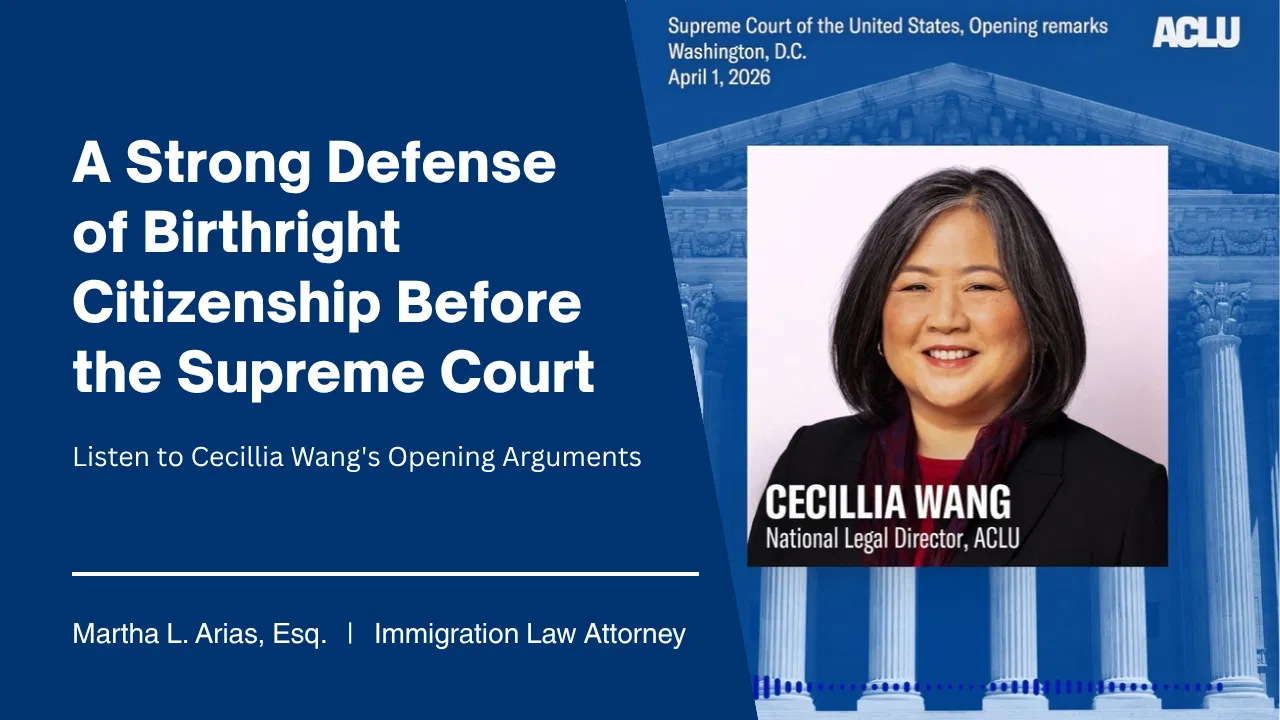
Today’s Supreme Court hearing focused on one of the most important constitutional questions in our country: whether birthright citizenship can be limited by executive action.
In her opening statement, ACLU National Legal Director Cecillia Wang argued that the rule has long been clear: people born in the United States are citizens. She said this principle was firmly protected by the Fourteenth Amendment so that no government official could take it away.
She also pointed to the Supreme Court’s historic decision in Wong Kim Ark, explaining that the Court already rejected a similar effort to deny citizenship based on the status of a child’s parents. According to her argument, that precedent leaves no room for the government’s new theory that a parent’s domicile should control whether a child born here is a citizen.
Wang also stressed that this issue is not only about legal theory. She warned that if the government’s position were accepted, thousands of babies born in the United States could immediately lose recognition of their citizenship, and the status of millions of Americans could be placed into question.
Her message to the Court was direct: the Constitution, history, and long-settled law support a bright-line rule that protects birthright citizenship and prevents manipulation by changing political agendas.
This hearing shows how serious the stakes are. Birthright citizenship has long been understood as a basic constitutional protection, and today’s argument was a forceful defense of that principle.
Disclaimer: This post is for general informational purposes only and does not constitute legal advice.