Any Questions?
We are ready to answer all your questions. Just fill the form and we will call you soon.
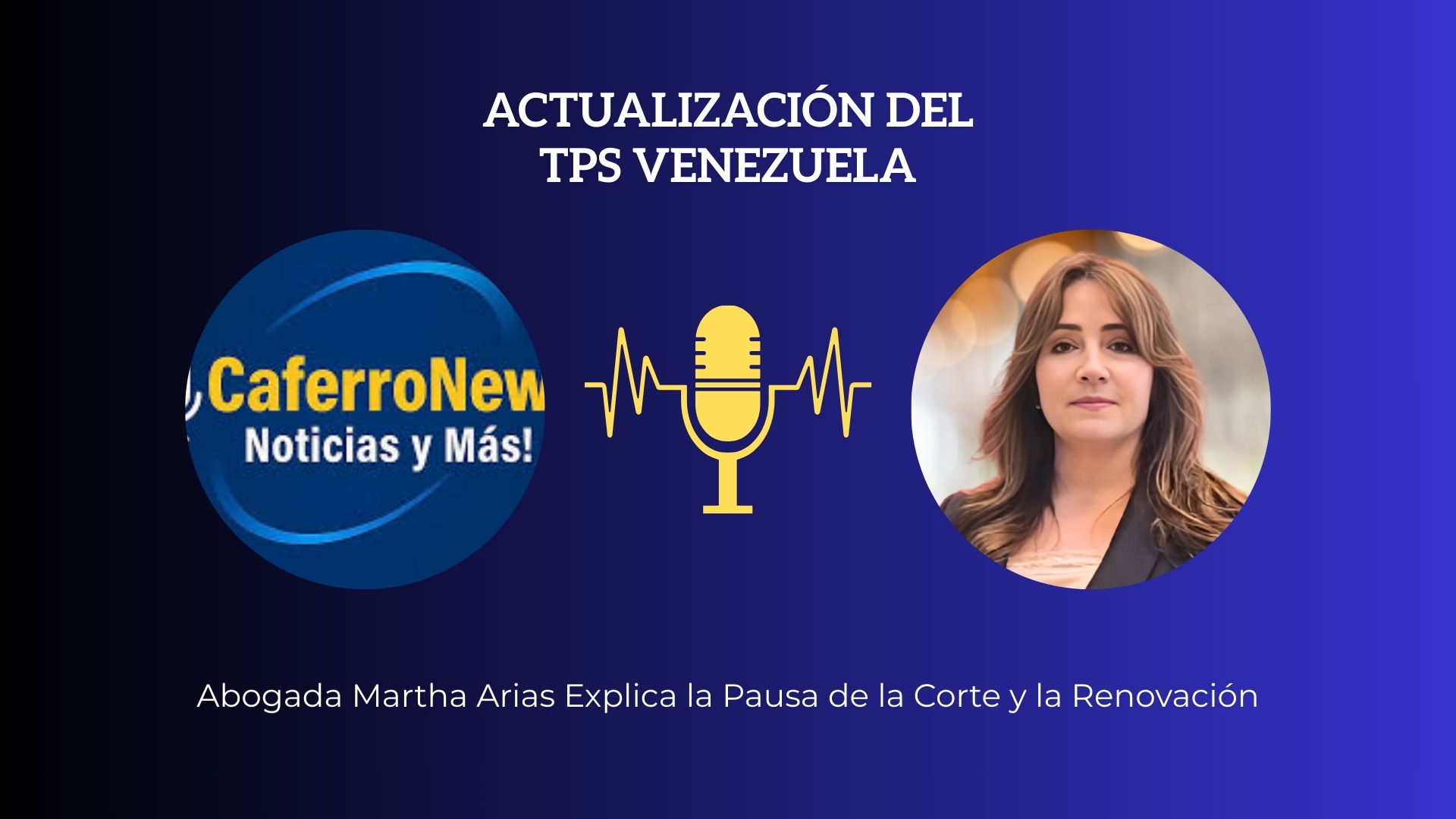
Yesterday, I had the pleasure of joining Caferro on his program Caferro News to talk about one of the most confusing immigration issues we are currently facing: the situation of Temporary Protected Status (TPS) for Venezuelans.
As I explained during the interview, the Department of Homeland Security announced the termination of the 2021 TPS for Venezuela, but a judge in California placed that decision on hold. The government immediately appealed that pause, and now the appeals court has ruled that the pause remains in place.
What does this mean? For now, Venezuelans with TPS from 2021 are still considered protected. However, this protection may only last until November 2025, when the 60-day grace period ends. After that, it is uncertain whether TPS will continue.
Many people ask me whether they should re-register for TPS now. The USCIS system does not allow electronic filing for Venezuela TPS at this time. In my practice, I am sending paper applications by mail, even though there is a risk they may be rejected, denied, or placed on hold. The reason is that filing may help protect individuals if the courts later uphold TPS, just as it happened earlier this year when certain re-registrants were granted TPS and work permits valid through 2026.
We also touched on another important issue: carrying proof of citizenship or legal status. A driver’s license is not valid proof. Carrying an actual passport is risky, but you can keep a reduced laminated copy of the ID page, obtain a passport card, or carry a digital copy of your U.S. birth certificate.
Immigration law is always changing, and this TPS situation is especially complex.
If you have questions about your case, you can call my office at 305-671-0018.
Stay informed, protect your rights, and never hesitate to seek professional advice.
FOLLOW ME ON SOCIAL MEDIA
CAFERRO:
Y bueno, y hasta ahora, pues, como te lo prometí, voy a saludar a una gran abogada colombiana que reside hace muchos años acá en los Estados Unidos. Tiene muchísima experiencia en inmigración. Martha Arias, y con ella voy a conversar en referencia a toda esta situación que se está viviendo. Martha, un saludo muy especial para ti. Buenos días. Bienvenida a Caferro News. Gracias por acompañarme.
ABOGADA MARTHA ARIAS:
Buenos días, Caferro. Un saludo muy especial para usted y toda su audiencia. Es un honor para mí estar aquí. Muchas gracias por la invitación.
CAFERRO:
Bueno, Martha, hay muchas preguntas de inmigración. No sé por dónde empezar, pero la más reciente es sobre la situación del TPS para los venezolanos, donde incluso mire que acá en el condado Miami-Dade, según el recaudador de impuestos, los venezolanos podrían renovar o solicitar licencia para estas personas. ¿Por qué no nos aclaras un poquito sobre lo que está pasando, Martha?
ABOGADA MARTHA ARIAS:
Bueno, a ver, esto del TPS es súper confuso tanto para las personas como incluso para nosotros como abogados. Lo que está pasando es lo siguiente: el Departamento de Seguridad Nacional terminó el TPS para los venezolanos, y estoy hablando del TPS del 2021.
Daba 60 días, o sea, hasta el 8 de noviembre, como período de gracia. Esa decisión fue apelada, o más bien fue demandada en California, y un juez pausó esa terminación. Eso fue en agosto. Esa terminación la pausó el juez. No fue el 5 de septiembre, sino la semana pasada. Inmediatamente, al otro día, el gobierno apeló esa pausa, es decir, pidió que se continuara la terminación del TPS. Y pues la información que usted nos da hoy, la verdad confieso, no me la he leído toda porque esto salió creo que anoche, en las pasadas horas.
Entonces, la decisión de esa sala de apelación ahora es que continúa la pausa, es decir, que se detiene la terminación del TPS. ¿Esto qué quiere decir? Que las personas que tienen TPS Venezuela —y estoy hablando del TPS del 2021— todavía podrían considerarse que están protegidas con el TPS.
Yo sé que es muy confusa esta situación, Caferro, por lo siguiente: técnicamente el TPS del 2021 terminaba el 10 de septiembre para la mayoría, algunos el 8 de septiembre. Hoy estamos a 11 de septiembre, lo que quiere decir que ese TPS técnicamente pudo haber ya terminado. Esta era prórroga que tienen de 60 días hasta noviembre, que sería noviembre de este año. Esa prórroga es la que les da este derecho junto con la decisión del juez.
¿Qué es lo que vamos a ver? Vamos a ver que la demanda o litigio sobre el TPS, si debe terminar o no, continúa. Entonces no sabemos si después de noviembre ese TPS va a continuar o no. Tenemos 60 días de gracia, el juez lo pausó. Puede ser que continúe después de noviembre.
Entonces la pregunta es: ¿qué deben hacer esas personas que tienen esa tarjeta de permiso de trabajo o ese TPS hasta septiembre? ¿Deben reregistrarse o no? Esa es una pregunta muy difícil de contestar para alguien que diga “esta es la respuesta correcta” porque fíjese: si usted se va ahora a la página web de USCIS a tratar de hacer una reregistración del TPS en forma electrónica, el sistema no le da la opción de TPS de Venezuela.
Solo le va a dar el menú de opciones de TPS que están vigentes, y no da la opción de Venezuela.
¿Qué quiere decir? Que en línea, electrónicamente, no va a poder hacer una registración.
¿Qué estoy haciendo yo? Yo personalmente estoy mandando las aplicaciones por correo, en papel, advirtiéndole a las personas que inmigración puede rechazar esa petición y devolverla; puede ser otra cosa que puede pasar, que se quede con la petición y la deje en “hold” o lo que se llama “on abeyance” hasta que salga este litigio o hasta noviembre; o puede ser que la apruebe, o puede ser que la niegue.
Como abogados, nosotros no podemos decir en este momento “esta es la solución” y “esto es lo que va a pasar” porque es una situación ambigua.
¿Por qué yo recomendaría que hagan una registración, aunque sea mandando el papel? Lo recomendaría porque no sabemos qué va a salir en las cortes, cuál va a ser el litigio final. Entonces puede pasar como pasó a principios de este año, cuando Biden anunció la terminación del TPS del 2023 y del 2021, los puso juntos y dio una extensión hasta el año entrante.
Las personas que alcanzaron a presentar la petición de la reregistración antes del 5 de febrero de este año 2025, muchas de ellas se las aprobaron. Ese TPS y ese permiso de trabajo siguen válidos, y a esas personas se los aprobaron hasta octubre de 2026. Es un pequeño grupo que quedó protegido porque actuó con esa notificación del gobierno. Se presentó la demanda en la corte y la corte protegió a ese pequeño grupo.
Entonces, siguiendo esa analogía y ese precedente, yo digo: en este momento estamos en una situación parecida. Presente la renovación y miramos a ver qué pasa. Lo peor que puede pasar, Caferro, es que pierdan la platica, pero se dan esa oportunidad.
CAFERRO:
Bueno, abogada Martha Arias, ya voy con mi siguiente invitado también para hablar sobre otro tema muy importante, pero no puedo dejarla ir sin preguntarle, porque muchas personas me han dicho: “Caferro, cuando entrevistas a una abogada de inmigración, pregúntale porque hay mucha incertidumbre con la realidad de ICE”. ¿Es recomendable incluso para los ciudadanos, incluso para los residentes, andar con el pasaporte en el bolsillo o con la residencia en el bolsillo por si alguna redada? Porque se han visto casos, no en el estado de la Florida, pero en otros estados donde piden prueba de ciudadanía. La licencia de conducir no es una prueba de ciudadanía o de residencia o de estatus.
ABOGADA MARTHA ARIAS:
No lo es, aunque las oficinas de licencia sí tienen la información de si la persona es ciudadana o residente, porque usted sabe que no les dan una licencia de conducir aquí en la Florida si no tiene un estatus.
Entonces no, la licencia no es prueba.
A mí personalmente me parece que andar con el pasaporte es peligroso. Lo que pueden hacer las personas es sacar una copia reducida y laminada de su pasaporte, por lo menos de la hoja donde está la foto y la información biográfica, y guardarla en su billetera para no andar con el pasaporte en la mano.
O sacar la tarjeta de pasaporte. Cuesta un dinero, creo que como 85 dólares, se pide en la oficina de pasaportes, y esa tarjetica es más fácil de cargar en la billetera. Entonces esa es una buena opción.
Los que nacieron en Estados Unidos, también les podría decir que carguen una copia de su certificado de nacimiento. El certificado de nacimiento de acá es muy pequeño. Aunque sea una copia digital, que la mantengan con ellos. Esa sería una recomendación.
CAFERRO:
Definitivamente. Bueno, abogada Martha Arias, el tiempo como se dice es corto. ¿Dónde la pueden ubicar, su página, su número telefónico, para más preguntas? Porque en inmigración definitivamente hay muchas preguntas.
ABOGADA MARTHA ARIAS:
Sí, efectivamente, Caferro. Mi teléfono es 305-671-0018. Tengo otro número: 305-233-3110. Mi página web es AriasVilla.com. Así es el nombre de la oficina, abogado AriasVilla.com; o simplemente ponen mi nombre “Martha Arias, abogada de inmigración” y en todas las redes sociales me van a encontrar.
CAFERRO:
Claro, ahí está en pantalla el número telefónico que acaba de dar la abogada Martha Arias. Pues Martha, muchísimas gracias, te seguiré entrevistando, comentando, porque noticias de inmigración hay todos los días. Muchas gracias por acompañarme en este debut de Caferro News acá en YouTube y vamos creciendo, gracias por apoyarme.
ABOGADA MARTHA ARIAS:
Muchísimas gracias por invitarme, Caferro. Todo el éxito del mundo para usted y su programa.
CAFERRO:
Gracias, muy amable la abogada Martha Arias, abogada de inmigración.
CAFERRO:
And well, and up to now, as I promised you, I am going to greet a great Colombian attorney who has lived for many years here in the United States. She has a lot of experience in immigration. Martha Arias, and with her I am going to talk in reference to all this situation that is happening. Martha, a very special greeting to you. Good morning. Welcome to Caferro News. Thank you for joining me.
ATTORNEY MARTHA ARIAS:
Good morning, Caferro. A very special greeting to you and all your audience. It is an honor for me to be here. Thank you very much for the invitation.
CAFERRO:
Well, Martha, there are many immigration questions. I don’t know where to start, but the most recent one is about the situation of TPS for Venezuelans, where even, look, here in Miami-Dade County, according to the tax collector, Venezuelans could renew or apply for a driver’s license. Why don’t you clarify for us a little bit about what is happening, Martha?
ATTORNEY MARTHA ARIAS:
Well, let’s see, this TPS matter is super confusing both for people as well as even for us as attorneys. What is happening is the following: the Department of Homeland Security ended TPS for Venezuelans, and I am talking about the TPS of 2021.
It gave 60 days, that is, until November 8, as a grace period. That decision was appealed, or rather was sued in California, and a judge paused that termination. That was in August. That termination was paused by the judge. It wasn’t September 5 last week. Immediately, the next day, the government appealed that pause, meaning asking that the termination continue — in other words, of the TPS.
And well, the information that you give us today, honestly I confess, I have not read it all because this came out, I think last night, in the past hours.
So the decision of that appeals court now is that the pause continues, meaning the termination of TPS is stopped. What does this mean? This means that the people who have TPS Venezuela — and I am talking about the TPS of 2021 — those people could still be considered protected with TPS.
I know this situation is very confusing, Caferro, for the following reason: technically the TPS of 2021 ended or was ending September 10 for the majority, for some September 8. Today we are on September 11, which means that TPS technically could have already ended. This was an extension they had of 60 days until November, which would be November of this year. This extension is the one that gives them this right together with this judge’s decision.
What are we going to see? We are going to see that the lawsuit or litigation about TPS, whether it should end or not, continues. So we do not know if after November that TPS will continue or not. We have 60 days of grace; the judge paused it. It could be that it continues after November.
So the question is: what should those people who have that work permit card or that TPS until September do? Should they re-register or not? That is a very difficult question to answer for anyone to say “this is the correct answer,” because look: if you now go to the USCIS website to try to do a re-registration of TPS electronically, the system does not give you the option of TPS for Venezuela.
It will only give you the menu of TPS options that are current, and it does not give the option of Venezuela.
What does that mean? That online, electronically, you will not be able to do a registration.
What am I doing? I personally am sending the applications by mail, on paper, warning people that immigration may reject that petition and return it to us. Another thing that could happen is it may keep the petition and leave it on “hold,” or what is called “on abeyance,” until this litigation comes out or until November. Or it could approve it, or it could deny it.
As attorneys, we cannot say at this moment “this is the solution” and “this is what will happen,” because it is an ambiguous situation.
Why would I recommend that they do a registration, even if it is sending the paper? I would recommend it because we do not know what will come out in the courts, what will be the final litigation. So it could happen as it did at the beginning of this year, when Biden announced the termination of TPS of 2023 and of 2021, he put them together and gave an extension until next year.
The people who managed to file the petition for re-registration before February 5 of this year 2025, many of them were approved. That TPS and that work permit are still valid, and those people were approved until October 2026. It is a small group that was protected because they acted with that government notice. The lawsuit was filed in court and the court protected that small group.
So, following that analogy and that precedent, I say: at this moment we are in a similar fight. File the renewal and we will see what happens. The worst that can happen, Caferro, is that they lose the money, but they give themselves that opportunity.
CAFERRO:
Well, attorney Martha Arias, I am going to my next guest also to talk about another very important topic, but I cannot let you go without asking because many people have told me: “Caferro, when you interview an immigration attorney, ask her because there is a lot of uncertainty with ICE.” Is it advisable, even for citizens and even for residents, to walk around with the passport in the pocket or with the residency card in the pocket in case of a raid? Because there have been cases, not in the state of Florida, but in other states where they are asking for proof of citizenship. The driver’s license is not proof of citizenship or of residency or of status.
ATTORNEY MARTHA ARIAS:
It is not, although the driver’s license offices do have the information of whether the person is a citizen or resident, because you know that they do not give a driver’s license here in Florida if you do not have a status. So no, the license is not proof.
Personally, I think that carrying the passport is dangerous. What people can do is get a reduced copy, laminated, of their passport, at least of the page where the photo and biographical information are, and keep it in their wallet so as not to carry the passport in hand. Or get the passport card. It costs some money, I think about 85 dollars, you request it at the passport office, and that little card is easier to carry in the wallet. So that is a good option.
Those who were born in the United States, I could also tell them to carry a copy of their birth certificate. The birth certificate here is very small. Even a digital copy, keep it with them. That would be a recommendation.
CAFERRO:
Definitely. Well, attorney Martha Arias, as they say, time is short. Where can they reach you, your page, your phone number, for more questions? Because in immigration there are definitely many questions.
ATTORNEY MARTHA ARIAS:
Yes, indeed, Caferro. My phone number is 305-671-0018. I have another number: 305-233-3110.
My website is AriasVilla.com. That is the name of the office, attorney AriasVilla.com; or simply type my name “Martha Arias immigration attorney” and on all social networks you will find me.
CAFERRO:
Of course, there on screen is the phone number just given by attorney Martha Arias. Well, Martha, thank you very much, I will continue interviewing you, commenting, because immigration news comes every day. Thank you very much for joining me in this debut of Caferro News here on YouTube, and we keep growing, thank you for supporting me.
ATTORNEY MARTHA ARIAS:
Thank you very much for inviting me, Caferro. All the success in the world for you and your program.
CAFERRO:
Thank you, very kind, attorney Martha Arias, immigration attorney.