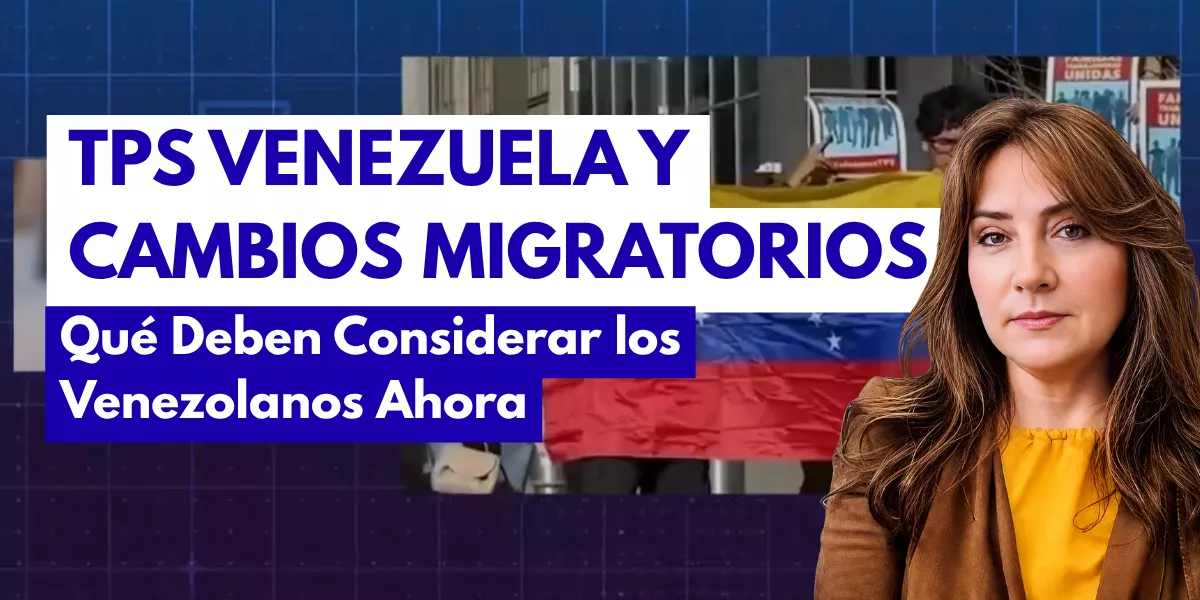
Venezuelan TPS: After the Government’s Appeal

During my conversation with journalist Orian Brito on September 9, I explained where things stand for Venezuelan nationals under Temporary Protected Status (TPS). Judge Edward Chen’s recent order keeps TPS in place for now, but the Department of Homeland Security has already appealed in the Ninth Circuit. As we have seen in prior TPS litigation, the legal fight can eventually reach the U.S. Supreme Court.
For those whose TPS (2021 designation) shows an expiration of September 10, there is an automatic 60‑day extension through November 10, 2025. In practice, that means your Employment Authorization Document (EAD) tied to TPS is also considered valid through that date, even if the card itself shows an earlier expiration. You may print the relevant USCIS notice and present it to your employer if asked for proof.
Because the litigation is fluid, I recommend re‑registering for TPS within the 60‑day window. If the courts later allow TPS to continue, your timely re‑registration helps keep you protected. If you also have other options—such as a family‑based petition, employment sponsorship, or a pending asylum case—these may offer more stability in the long run. Every situation is different; professional guidance matters.
If you need help evaluating your options or completing your TPS re‑registration, my office is here to assist at (305) 671‑0018 or ariasvilla.com. Stay informed, stay proactive, and please seek qualified legal advice before making important decisions.
Disclaimer: This post is for general informational purposes only and does not constitute legal advice. Reading it does not create an attorney‑client relationship. For advice about your specific situation, please consult a licensed attorney.
FOLLOW ME ON SOCIAL MEDIA
Spanish Transcript
ORIAN BRITO:
Amigos, 9 de septiembre. Más de medio millón de venezolanos con TPS en Estados Unidos están a la espera de la decisión del juez Edward Chen respecto a la apelación presentada por el Departamento de Seguridad Nacional, que busca poner fin a este beneficio migratorio. La incertidumbre es grande. Las preguntas son muchas. Ustedes me las dejan en esta red social, no solo por las licencias, sino también por qué va a pasar con el permiso de trabajo. Es una de las que leí.
Por eso, en este espacio vamos a conversar con la abogada de inmigración del sur de la Florida, Martha Arias, que nos va a ayudar a responder algunas dudas sobre lo que puede pasar con este programa, cuáles son los escenarios legales y qué significa este proceso para los venezolanos amparados bajo este estatus. Como siempre, los invito a que se queden, a que dejen sus preguntas y les agradezco que se suscriban y sean parte de esta comunidad.
Abogada, buenas tardes. El gobierno no tardó en apelar: el viernes celebramos la decisión del juez Chen y el sábado apeló. Estamos a la expectativa de lo que pueda decidirse. La apelación del gobierno pide que el juez, como que, desestime su propia decisión, algo que yo veo casi imposible, ¿no? ¿Cómo lo ve usted?
ABOGADA MARTHA ARIAS:
Yo lo veo poco probable, pero tampoco imposible porque, fíjese, la apelación se hace en el Noveno Circuito, que es el circuito que le corresponde a California. El Noveno Circuito se caracteriza por ser más bien demócrata o, como la gente lo llama, liberal. Entonces, sabemos que el juez Chen tiene una tendencia más demócrata. Por eso, no veo imposible que se mantenga esa decisión del juez. Pero, igual, el gobierno está presionando fuerte porque la intención del gobierno es terminar el TPS.
ORIAN BRITO:
¿Terminarlo, terminarlo…?
ABOGADA MARTHA ARIAS:
Sí. Lo mismo que pasó con el TPS del 2023 fue algo similar: ese TPS fue terminado, después el juez dijo que no; se apeló, se mantuvo esa decisión del juez; y el gobierno después fue a la Corte Suprema y la Corte Suprema fue la que finalmente dijo: “Sí, el gobierno lo puede terminar.” O sea, no fue el Noveno Circuito, la sala de apelaciones, la que dio la decisión final de terminar el TPS; la dio la misma Corte Suprema. Entonces, aquí puede pasar lo mismo.
ORIAN BRITO:
Cuando hablamos de que puede pasar lo mismo, quiere decir que, independientemente de que el juez tomó una decisión a favor, el gobierno podría —y esta pregunta me la han hecho ya esta semana— recurrir a esa vía de la Corte Suprema para decir: “Bueno, si esto lo pongo yo, ¿no tengo el derecho de quitarlo?”
ABOGADA MARTHA ARIAS:
No, pero lo que pasa es que no es, técnicamente, que él tenga el derecho de quitarlo, porque acuérdense que lo que él hizo fue una medida cautelar, que dijo: “No voy a permitir que se termine mientras el litigio continúa.” Entonces, lo que se apela es esa decisión de esa medida cautelar. Esa es la parte que puede subir a la Corte Suprema.
ORIAN BRITO:
Entre tanto, aquí hay un grupo de personas que se mantienen en un limbo. Hay dos situaciones evidentes, a juzgar por los comentarios que me hacen. Una tiene que ver con los permisos de trabajo. Algunos de estos permisos de trabajo tienen fecha de vencimiento tan pronto como mañana, 10 de septiembre, ¿no? Hay gente que me dice: “Ya sometí una extensión.” Hay gente que me dice: “Tengo dudas si es que esto automáticamente está extendido, aunque la fecha diga que vence mañana.” ¿Dónde estamos y qué se les puede decir a esas personas que tienen la incertidumbre y, por supuesto, el temor de perder su trabajo?
ABOGADA MARTHA ARIAS:
Claro. Bueno, no es fácil, es complicado, pero a ver: cuando la Secretaría de Seguridad Nacional terminó el TPS del 2021 —que vence mañana—, al terminarlo, dio una prórroga automática, vamos a decir, como un periodo de prueba de 60 días. Esto quiere decir que hasta el 10 de noviembre de 2025 esos venezolanos que tenían el TPS que vence mañana, 10 de septiembre, tendrían esa prórroga automática hasta el 10 de noviembre. Eso quiere decir que su permiso de trabajo también sigue siendo válido hasta esa fecha, aunque la tarjeta diga que venció el 10 de septiembre. Es una prórroga automática.
La persona puede imprimir de la página web de inmigración la información de esa prórroga para presentársela a su empleador, si el empleador le pide esa prueba o no sabe cuál es el estatus migratorio ni la validez de ese trabajo.
Ahora, yo también les estoy recomendando a las personas que hagan una re-registración del TPS a partir de mañana, dentro de este periodo de 60 días. ¿Por qué? Porque no sabemos cómo va a continuar el litigio y, vamos a decir, que tengan la suerte de que en alguna parte de este litigio se extienda otra vez el TPS; entonces, la persona va a quedar protegida por esa re-registración que ya haya hecho.
Entonces, la situación es: la validez sería hasta el 10 de noviembre de este año, a no ser que algo, en alguna de estas cortes, autorice otra vez que se continúe con el TPS.
ORIAN BRITO:
Bueno, registrarse y entender que esa extensión podría ser, por lo pronto, para los del TPS 2021, válida por 60 días. Ahora, la gran incertidumbre es qué puede pasar después, porque los días pasan.
ABOGADA MARTHA ARIAS:
La incertidumbre es qué puede pasar después. Si hay, de pronto, alguna demanda o algo que permita que estos venezolanos puedan continuar con el TPS, pues veremos qué va a pasar. Por ahora, seguimos con el vaivén de las cosas. Todos los días es algo distinto: hay una decisión que lo termina, después una apelación dice que no, y en esas vamos. Pero, por ahora, hoy que estamos hablando, 9 de septiembre, este TPS está extendido, sigue extendido.
O sea, el gobierno apeló el sábado; esa decisión de apelación no va a salir todavía. Entonces, hoy tenemos en firme la decisión del juez Chen, del viernes, que dijo que el TPS debería continuar.
ORIAN BRITO:
OK. Aunque, en el sistema, los comentarios son variados. Hay personas que se han podido registrar, pero no les dan recibo. Otros sí lo tienen. Hay gente que no puede sacar una licencia; ha sido todo un tema…
ABOGADA MARTHA ARIAS:
Los de la licencia: sí deberían permitirles sacar licencia porque el mismo boletín, o el mismo documento, dice que tiene 60 días de validez.
ORIAN BRITO:
De hecho, el propio recaudador de impuestos de Miami-Dade nos envió un comunicado donde decía que, a esas personas con ese TPS —más el permiso de trabajo—, esos eran los documentos que les permitían a la gente obtener la licencia, y lo iban a recibir hasta el 7 de noviembre de este año. Por cuánto lo van a extender o por cuánto les van a dar la licencia no me queda claro.
ABOGADA MARTHA ARIAS:
Yo me imagino que si van antes, se la van a dar hasta los 60 días, hasta el vencimiento de esos 60 días, que en este caso sería el 10 de noviembre de 2025. No se la pueden dar por más tiempo, porque hasta allí es que van a tener el estatus.
ORIAN BRITO:
Claro. Bueno, quiero leer algunos de los comentarios porque, abogada, estoy contento además porque la he perseguido durante varios días; está muy full y hoy nos puede acompañar. Siempre me gusta porque —como lo digo—, abogada, hay mucha gente que entiendo que, en medio del nerviosismo, se irrita. A veces el abogado no dice lo que la gente quiere escuchar, pero yo creo que, en este momento, la preparación y escuchar, sobre todo, lo que no te gusta, es lo que te puede brindar la verdadera luz del camino a seguir, para que busques una forma y te estabilices en el país.
ABOGADA MARTHA ARIAS:
Exacto. El problema es que hay personas que sí tienen una forma de resolver su estatus migratorio porque tienen un esposo ciudadano americano o residente, o tienen una petición familiar de un padre o un hermano.
ORIAN BRITO:
O un empleador.
ABOGADA MARTHA ARIAS:
O un empleador. Otros, pues, que tienen el asilo pendiente, que les puede continuar dando una protección. Pero muchas personas que no tienen ninguna otra forma de resolver su estatus migratorio —no tienen ninguna petición familiar, ninguna petición de empleador—, realmente lo que tienen que hacer es tratar de resolver su situación; si no lo pueden hacer, entonces pensar en la posibilidad de irse. Porque veo difícil que una persona se pueda quedar indocumentada en Estados Unidos, como estamos viendo las cosas: están aumentando los procesos de deportación rápida y estas deportaciones masivas que estamos viendo en esta administración.
Entonces, yo creo que sería demasiado tenso y presionante para una persona quedarse definitivamente sin estatus migratorio.
ORIAN BRITO:
Sí, sí. Y hay que estar pendiente, porque esta batalla es judicial. Aunque el juez pueda rechazar la apelación del gobierno, el gobierno va a buscar otros mecanismos para llevar esto adonde consiga lo que pretende, que es poner fin al programa.
ABOGADA MARTHA ARIAS:
Correcto.
ORIAN BRITO:
Gracias. Bueno, Douglas Rodríguez, un gran abrazo. Dice: “Eres uno de los pocos que da información tal cual, sin falsas expectativas. Siempre veo tu programa y me parece excelente porque dices las cosas con claridad y sin adornos. Quien quiere escuchar la verdad sabe que aquí la consigue. No existe otro espacio igual.” Muchísimas gracias, Douglas, y un fuerte abrazo. Ese es el compromiso. Yo, insisto, abogada, yo no quería hacer de este espacio algo dedicado a la inmigración, porque hay tantos temas en el mundo: temas políticos, temas de interés, destinos que uno visita y conoce y quisiera compartir. Pero la vida y la gente me han llevado a este camino, y es el compromiso de seguir, ¿no? Para ayudarlos en la medida de lo posible.
Otra persona me pide que demos su nombre. Saludos desde Columbus, Ohio. Pudo renovar su licencia en el DMV de la zona norte. No le preguntaron nada; solo se presentó como si fuera a sacarse una cédula, con buena presencia, con buena actitud y una sonrisa. Con todo en la mano, la renovación se la dieron —escuchen— hasta 28 de marzo de 2026. Solo le pidieron la licencia que está por vencer, prueba de residencia; mostró su TPS 2021, su permiso de trabajo —este permiso de trabajo vencido en 2022— con el papel de recibido: ya está aprobado, solo tiene que esperar la carta de aprobación y los documentos. Este es por asilo. Todo fluyó bien, más de lo que pensaba. ¡Qué bueno, qué bueno! Porque tener la licencia —y sabía que ese era uno de los sitios donde más se registraban problemas—…
La pregunta es: ¿qué pasa si hay retrasos en la renovación de mi permiso de trabajo? —pregunta María Gómez.
ABOGADA MARTHA ARIAS:
Sí, pero ¿el permiso de trabajo a través de TPS?
ORIAN BRITO:
De TPS, sí.
ABOGADA MARTHA ARIAS:
Bueno, si hay retrasos porque la persona vaya a hacer una re-registración y su caso está en trámite, lo que habrá es que esperar el retraso. No creo que el gobierno vaya a apurarse a aprobar un permiso de trabajo cuando el mismo gobierno está pretendiendo terminar el TPS. Entonces, hacer esa re-registración y volver a pedir el permiso es como una protección, y tener ese recibo que muestra que la persona lo hizo. Pero, la verdad, no creo que esa petición de permiso de trabajo vaya a llegar muy rápido.
ORIAN BRITO:
OK. Liliana Torres: “Hoy fui a sacar la licencia —ayer, lunes— y no me la dieron porque dicen que no tienen autorización.” Es el verdadero drama. Hola, Orian: todavía no se ha publicado la decisión del juez Chen para registrarse en el TPS. ¿Debo esperar que se publique en inmigración esa decisión y si acatará la sentencia del juez Chen? ¿Cuándo podremos registrarnos o hago la registración de mi TPS 2023 sin esperar más?
ABOGADA MARTHA ARIAS:
El del 2023, no. Yo haría las re-registraciones del TPS 2021, que es el que vence mañana. El TPS del 2023 realmente está —vamos a decir— casi que muerto; pues todavía hay un litigio que continúa, pero no veo la posibilidad allí. Sí es cierto que el gobierno no ha publicado la decisión del juez Chen del viernes. Y no creo que la vaya a publicar tampoco. Yo no creo que el gobierno esté asumiendo la posición de publicar esto, y más que apelaron el sábado. Entonces, sí, es un reto porque la persona que vaya a pedir la re-registración puede que el mismo gobierno se la devuelva; puede que se la acepte y le emita el recibo. La verdad, todos estamos aquí —vamos a decir— inventando.
ORIAN BRITO:
Un día a la vez, a la buena de Dios.
ABOGADA MARTHA ARIAS:
Exacto, a la buena de Dios. Esa es la palabra.
ORIAN BRITO:
Sí, es así, porque entonces usted va a intentar; si no viene, entonces no viene. Uno trata, pero esto es un sorteo. Esto es como cuando uno va a sacar la visa: uno llega a esa taquilla con buena actitud, con la mejor de las ganas, y puede ser que te reboten, que te digan que no, aunque tengas todos los documentos. Yo recuerdo que, antes de venir a este país, me la negaron dos veces. Abogada, eso para mí fue —la primera vez— un poco traumático porque, además, no pude hacer nada: estaba muy pequeño; mi mamá dijo que era madre soltera —no sé por qué dijo eso porque, aunque mi mamá estaba divorciada, yo tengo a mi papá y él se quedó—. Y la segunda vez, mi mamá había fallecido y, cuando llegué, me preguntaron —tenía 20 años, recuerdo— qué propiedad tenía. Y yo dije: “Bueno, ¿qué propiedad con 20 años podía tener?” Y me la negaron. Pero fue traumático, porque uno sale desmoralizado de ahí.
ABOGADA MARTHA ARIAS:
Claro. Cualquier negatoria de un proceso migratorio afecta a las personas, sea una simple visa de turista o…
ORIAN BRITO:
Eso es horrible, horrible. Perfecto. Dos preguntas más para concluir. Alba Alcalá: “Del TPS 2021 salí del asilo de mi mamá por matrimonio con ciudadano. Permiso de trabajo por asilo. ¿Debo pedirlo por TPS? No he hecho ajuste todavía.”
ABOGADA MARTHA ARIAS:
Uy, pero esas preguntas están como enredadas, porque lo que entendí es…
ORIAN BRITO:
Salió del asilo.
ABOGADA MARTHA ARIAS:
…salió del asilo porque se casó con ciudadano americano. Pero tiene TPS; vuelve y desisto. Pero, para que haya TPS, está casada con ciudadano americano…
ORIAN BRITO:
Ahora, si yo tuviese asilo y TPS, preferiría —en mi caso— pedir mi permiso de trabajo por el asilo más que por el TPS. Usted me corrige.
ABOGADA MARTHA ARIAS:
Claro, claro, por el asilo, porque le va a dar más tiempo, y, pues, el asilo, en este momento, no tiene la persona la cita. En cambio, el TPS sí; ya vemos que lo están terminando.
ORIAN BRITO:
Perfecto. Otra persona dice: “Me registré, pero no he pedido el permiso de trabajo.” Bueno, tienes que pedirlo, porque lo peor es que no te lo den; pero hay que trabajar, a menos que no lo necesites, ¿no?
Bueno, abogada, me gustaría que quede su número de contacto. Gracias por dedicarnos estos minutos. Por supuesto, vamos a estar muy pendientes a la decisión, a la respuesta que pueda dar —por supuesto— el gobierno, para ampliarla a todos ustedes. Y me gustaría que cualquier persona que desee tener la asesoría de la abogada Martha Arias, que, además, tiene un espacio a las siete en América Radio 1260 AM, siempre lo utilizamos en los diversos espacios para la red de temas de inmigración… Me gusta que hoy me haya acompañado. ¿Dónde la pueden contactar?
ABOGADA MARTHA ARIAS:
Sí, muchas gracias, Orian. Muchas gracias por invitarme. Efectivamente, los martes a las 7:00 p. m., en América Radio, tenemos el programa donde contestamos preguntas a los oyentes. Mi teléfono de oficina es el 305-671-0018. Pueden buscarme en mi página web ariasvilla.com.
ORIAN BRITO:
¿Cuántos años, abogada, tiene usted ejerciendo aquí en el sur de la Florida?
ABOGADA MARTHA ARIAS:
Sí, como abogada de inmigración ejerciendo aquí, en el sur de la Florida, llevo 22 años, desde el 2003. Bastante tiempo. Exitosamente y con mucho orgullo he ejercido este derecho migratorio por 22 años. Me apasiona el tema, me encanta. Sí tengo que reconocer que este año ha sido uno de los años más retadores de la práctica migratoria, y en este sentido comparte la mayoría de los abogados de inmigración. Es muy difícil porque hay muchos cambios; hay unas políticas muy fuertes, agresivas, y, pues, esto hace que la práctica sea mucho más complicada y menos motivante, vamos a decir, pero, pues, tenemos que seguir en esa lucha.
ORIAN BRITO:
Además, hemos hecho un trabajo bonito porque los abogados, por un lado, explican, interpretan la ley, nos ponen al día de lo que está pasando; pero ya hemos hecho una relación entre abogados y periodistas donde drenamos, discutimos, nos reímos de las cosas de las que nos podemos reír, nos molestamos cuando hay que molestarse, pero vamos haciendo como una especie de soporte emocional, ¿no?
ABOGADA MARTHA ARIAS:
Sí; o sea, en realidad es, precisamente, mostrar esa noticia diaria, mostrar esa política administrativa que, pues, lo más que uno puede es tratar de abogar porque se haga validez a la ley y a la Constitución, a los principios del derecho; pero, pues, tampoco nosotros los abogados podemos más que hacer eso. Obviamente, las políticas administrativas las establece cada nuevo presidente. Y estamos viendo que, aunque la ley no ha cambiado mucho, las políticas administrativas sí; y tenemos una cantidad de nuevas políticas administrativas en adición a una, pues, que es la más impactante en este momento, que es uno de los procesos de desnaturalización —es decir, tratar de quitarle la ciudadanía a las personas que adquirieron en algún momento su residencia o la ciudadanía misma con fraude, con mentiras—.
Entonces, estamos en un proceso de cambios muy constantes y, aparte de los cambios constantes, una política migratoria muy estricta. Por ejemplo, personas que tenían una orden de deportación y podían reabrir sus casos: uno les presentaba una petición familiar si estaban casados con ciudadano americano —por ejemplo—, o un hijo ciudadano americano, adulto, que los pedía; uno presentaba la petición y rara vez les daban una cita. Ahora les están dando cita y los están deteniendo en esa cita si tienen orden de deportación. Quiere decir que le importa la posibilidad de hacer una reapertura para esa persona para poder ajustar su estatus. Y importa muchos otros beneficios, como esos perdones que uno presentaba —la persona estando aquí— para poder ir fuera de los Estados Unidos a recibir la residencia. Si esa persona tiene una orden final, pues uno ya no va a querer presentar esa I‑130 o esa petición, porque hay una gran probabilidad de que los detengan, los arresten, al entrevistarlos.
Entonces, estos son esos cambios y esto es lo que está pasando en este momento.
ORIAN BRITO:
Gracias, abogada, por agregar esta realidad que se está viviendo, y es importante, por eso, que usted se asesore bien antes de asistir a alguna cita o someter alguna planilla. Eso es fundamental. Una asesoría en este momento puede hacer la diferencia en medio de estos cambios que se están viviendo —como lo describe la abogada Martha Arias—. Usted ya tiene aquí información precisa; hemos respondido a algunas de sus preguntas, las recurrentes. Le invito a que comparta esta información con algún familiar o conocido que esté en esta situación y, por supuesto, mañana nos volvemos a conectar con otra cosa que pueda ocurrir en el tema migratorio aquí en Estados Unidos.
Gracias, abogada, y muy buenas tardes —o buenas noches ya para todos—.
ABOGADA MARTHA ARIAS:
Gracias, Orian. Felicidades para todos. Hasta la próxima.
ORIAN BRITO:
Hasta la próxima.
English Translation
ORIAN BRITO:
Friends, September 9. More than half a million Venezuelans with TPS in the United States are awaiting Judge Edward Chen’s decision regarding the appeal filed by the Department of Homeland Security, which seeks to end this immigration benefit. The uncertainty is great. The questions are many. You leave them for me on this social network—not only about driver’s licenses, but also about what will happen with the work permit. That is one of the questions I read.
That is why, in this space, we are going to talk with the immigration attorney from South Florida, Martha Arias, who is going to help us answer some doubts about what could happen with this program, what the legal scenarios are, and what this process means for Venezuelans protected under this status. As always, I invite you to stay, to leave your questions, and I thank you for subscribing and being part of this community.
Attorney, good afternoon. The government did not take long to appeal: on Friday we celebrated Judge Chen’s decision, and on Saturday it appealed. We are waiting to see what might be decided. The government’s appeal asks the judge to, sort of, dismiss his own decision—something I see as almost impossible, right? How do you see it?
ATTORNEY MARTHA ARIAS:
I see it as unlikely, but not impossible either, because, look, the appeal is being made in the Ninth Circuit, which is the circuit that corresponds to California. The Ninth Circuit is known for being more Democratic or, as people call it, liberal. So we know that Judge Chen has a more Democratic tendency. Therefore, I do not see it as impossible that the judge’s decision will be maintained. But still, the government is pressing hard because the government’s intention is to end TPS.
ORIAN BRITO:
End it, end it…?
ATTORNEY MARTHA ARIAS:
Yes. The same thing that happened with TPS in 2023 was something similar: that TPS was ended; then the judge said no; it was appealed; that judge’s decision was maintained; and the government later went to the Supreme Court. And the Supreme Court was the one that finally said: “Yes, the government can end it.” In other words, it was not the Ninth Circuit, the court of appeals, that gave the final decision to end TPS; it was the Supreme Court itself. So, the same thing could happen here.
ORIAN BRITO:
When we say the same thing could happen, it means that, regardless of the judge having made a decision in favor, the government could—and this question has already been asked to me this week—resort to that path to the Supreme Court to say: “Well, if I granted this, don’t I have the right to take it away?”
ATTORNEY MARTHA ARIAS:
No, but what happens is that it is not, technically, that he has the right to take it away, because remember that what he issued was a preliminary injunction, which said: “I will not allow it to end while the litigation continues.” So what is being appealed is that injunction. That is the part that could go up to the Supreme Court.
ORIAN BRITO:
Meanwhile, there is a group of people who remain in limbo. There are two evident situations, judging by the comments I receive. One has to do with work permits. Some of these work permits have an expiration date as soon as tomorrow, September 10. Some people tell me, “I already submitted an extension.” Others tell me, “I have doubts whether this is automatically extended, even though the date says it expires tomorrow.” Where do we stand, and what can be said to those people who have the uncertainty and, of course, the fear of losing their jobs?
ATTORNEY MARTHA ARIAS:
Of course. Well, it is not easy; it is complicated, but let’s see: when the Department of Homeland Security ended TPS from 2021—which expires tomorrow—upon ending it, they granted an automatic extension, let’s say, like a 60-day grace period. This means that until November 10, 2025, those Venezuelans whose TPS says it expires tomorrow, September 10, would have that automatic extension until November 10. That means their work permit also continues to be valid until that date, even if the card says it expired on September 10. It is an automatic extension.
The person can print the information about that extension from the immigration website to present it to their employer, if the employer asks for that proof or does not know the immigration status or the validity of that work authorization.
Now, I am also recommending that people re-register for TPS starting tomorrow, within this 60-day period. Why? Because we do not know how the litigation will continue, and—let’s say—they get lucky that at some point during this litigation TPS is extended again; then, the person will be protected by that re-registration already done.
So, the situation is: the validity would be until November 10 of this year, unless something, in any of these courts, authorizes once again that TPS continue.
ORIAN BRITO:
Well, re-register and understand that this extension could be, for now, for those from TPS 2021, valid for 60 days. Now, the big uncertainty is what could happen after, because the days go by.
ATTORNEY MARTHA ARIAS:
The uncertainty is what could happen after. If there is, suddenly, some lawsuit or something that allows these Venezuelans to continue with TPS, then we will see what will happen. For now, we continue with the back-and-forth of things. Every day it is something different: there is a decision that ends it; then an appeal says no; and that is where we are. But for now, today as we speak, September 9, this TPS is extended; it remains extended.
That is, the government appealed on Saturday; that appeal decision will not come out yet. So today we have in force Judge Chen’s decision from Friday, which said that TPS should continue.
ORIAN BRITO:
OK. Although, in the system, the comments are varied. There are people who have been able to register but are not given a receipt. Others do have it. There are people who cannot get a driver’s license; it has been a whole issue…
ATTORNEY MARTHA ARIAS:
As for licenses: they should allow them to get a license because the same bulletin, or the same document, says it has 60 days of validity.
ORIAN BRITO:
In fact, the Miami-Dade tax collector himself sent us a statement saying that for those people with that TPS, plus the work permit, those were the documents that allowed people to obtain the license, and they were going to accept them until November 7 of this year. For how long they will extend it, or for how long they will issue the license, is not clear to me.
ATTORNEY MARTHA ARIAS:
I imagine that if they go before, they will issue it up to the 60 days, up to the expiration of those 60 days, which in this case would be November 10, 2025. They cannot issue the license for longer, because that is how long they will have status.
ORIAN BRITO:
Of course. Well, I want to read some of the comments because—attorney—I am happy; I have been trying to reach you for several days. You are very busy, and today you can join us. I always like it because—as I say—there are many people who, in the midst of nervousness, get irritated. Sometimes the attorney does not say what people want to hear, but I think that, at this moment, preparation and listening, especially to what you do not want to hear, is what can shed the true light on the path to follow, so that you can find a way and stabilize yourself in the country.
ATTORNEY MARTHA ARIAS:
Exactly. The problem is that there are people who do have a way to resolve their immigration status because they have a U.S. citizen or resident spouse, or they have a family petition from a parent or a sibling.
ORIAN BRITO:
Or an employer.
ATTORNEY MARTHA ARIAS:
Or an employer. Others have asylum pending, which can continue providing protection. But many people who have no other way to resolve their immigration status—no family petition, no employer petition—really what they have to do is try to resolve their situation; if they cannot, then think about the possibility of leaving. Because I find it difficult for someone to remain undocumented in the United States, as we are seeing things: the processes of expedited removal are increasing and these mass deportations we are seeing in this administration.
So I think it would be too tense and stressful for a person to remain definitively without immigration status.
ORIAN BRITO:
Yes, yes. And you have to be attentive because this battle is judicial. Even if the judge can reject the government’s appeal, the government will look for other mechanisms to take this to where it gets what it intends, which is to end the program.
ATTORNEY MARTHA ARIAS:
Correct.
ORIAN BRITO:
Thank you. Well, Douglas Rodríguez, a big hug. He says: “You are one of the few who gives information as it is, without false expectations. I always watch your program, and I think it is excellent because you say things clearly and without embellishment. Whoever wants to hear the truth knows they can find it here. There is no other space like it.” Thank you very much, Douglas, and a big hug. That is the commitment. I insist, attorney, I did not want to make this space something dedicated to immigration because there are so many topics in the world—political topics, topics of interest, destinations one visits and knows and would like to share. But life and people have led me down this path, and it is the commitment to continue, right? To help you as much as possible.
Another person asks me to give their name. Greetings from Columbus, Ohio. They were able to renew their license at the DMV in the north area. They were not asked anything; they just showed up as if to get an ID card—with good presence, good attitude, and a smile. With everything in hand, the renewal was granted—listen—until March 28, 2026. They were only asked for the license that was about to expire, proof of residence; they showed their TPS 2021, their work permit—this work permit expired in 2022—with the receipt; it is already approved; they just have to wait for the approval notice and the documents. This one is through asylum. Everything flowed well—better than expected. How good, how good, because having the license, and I knew that this was one of the places where more problems were reported…
The question is: “What happens if there are delays in the renewal of my work permit?” asks María Gómez.
ATTORNEY MARTHA ARIAS:
Yes, but the work permit through TPS?
ORIAN BRITO:
Through TPS, yes.
ATTORNEY MARTHA ARIAS:
Well, if there are delays because the person is going to do a re-registration and it will be processed, what they will have to do is wait; there will be delay. I do not think the government is going to hurry to approve a work permit when the same government is intending to end TPS. So doing that re-registration and requesting the work permit again is like a protection, and having that receipt that shows the person did it. But honestly, I do not think that work permit request will be approved very quickly.
ORIAN BRITO:
OK. Liliana Torres: “Today I went to get the license—yesterday, Monday—and they did not give it to me because they say they do not have authorization.” That is the real drama. Hello, Orian: the judge Chen’s decision has not yet been published to register for TPS. Should I wait for that decision to be published on immigration and whether they will comply with Judge Chen’s ruling? When will we be able to register, or do I do my TPS 2023 registration without waiting any longer?
ATTORNEY MARTHA ARIAS:
Not the one from 2023. I would do the re-registrations of TPS 2021, which is the one that expires tomorrow. TPS 2023 is really, let’s say, almost dead; there is still litigation that continues, but I do not see the possibility there. It is true that the government has not published Judge Chen’s decision from Friday. And I do not think they are going to publish it either. I do not think the government is taking the position to publish this, especially since they appealed on Saturday. So yes, it is a challenge because the person who goes to request the re-registration may have it returned by the government; or they may accept it and issue the receipt. Honestly, we are all here, let’s say, figuring it out.
ORIAN BRITO:
One day at a time, God willing.
ATTORNEY MARTHA ARIAS:
Exactly—God willing. That is the word.
ORIAN BRITO:
Yes, that is how it is, because then you will try; if it does not come, then it does not come. One tries, but this is a lottery. It is like when one goes to get a visa: you arrive at the window with a good attitude, with the best disposition, and you may be rejected, told no, even if you have all the documents. I remember that, before coming to this country, I was denied twice. Attorney, that was— the first time— a bit traumatic for me because, in addition, I could not do anything: I was very young; my mother said that she was a single mother—I do not know why she said that because, although my mother was divorced, I have my father and he stayed. And the second time, my mother had passed away and, when I arrived, they asked me— I was 20 years old, I remember— what property I had. And I said, “Well, what property could I have at 20 years old?” And they denied me. But it was traumatic, because one leaves there demoralized.
ATTORNEY MARTHA ARIAS:
Of course. Any denial of an immigration process affects people—be it a simple tourist visa or…
ORIAN BRITO:
It is horrible, horrible. Perfect. Two more questions to conclude. Alba Alcalá: “From TPS 2021 I left my mother’s asylum due to marriage to a citizen. Work permit through asylum. Should I request it through TPS? I have not done adjustment yet.”
ATTORNEY MARTHA ARIAS:
Wow, but those questions are a bit tangled, because what I understood is…
ORIAN BRITO:
She left asylum.
ATTORNEY MARTHA ARIAS:
…she left asylum because she married a U.S. citizen. But she has TPS; I go back and desist. But for there to be TPS, she is married to a U.S. citizen…
ORIAN BRITO:
Now, if I had asylum and TPS, I would prefer—in my case— to request my work permit through asylum rather than through TPS. You correct me.
ATTORNEY MARTHA ARIAS:
Of course, of course—through asylum—because it will give more time, and, well, with asylum, at this moment, the person does not have the interview scheduled. In contrast, TPS—as we can see— they are ending it.
ORIAN BRITO:
Perfect. Another person says: “I registered but I have not requested the work permit.” Well, you have to request it, because the worst thing is that they do not grant it; but you need to work, unless you do not need it, right?
Well, attorney, I would like your contact number to remain on record. Thank you for giving us these minutes. Of course, we are going to be very attentive to the decision, to the response that the government may give, to share it with all of you. And I would like that any person who wishes to have the advice of attorney Martha Arias, who also has a segment at seven on América Radio 1260 AM, which we always use in various spaces for the network on immigration topics… I am glad you joined me today. Where can they contact you?
ATTORNEY MARTHA ARIAS:
Yes, thank you very much, Orian. Thank you very much for inviting me. Indeed, on Tuesdays at 7:00 p.m., on América Radio, we have the program where we answer listeners’ questions. My office phone number is 305-671-0018. You can find me on my website ariasvilla.com.
ORIAN BRITO:
How many years, attorney, have you been practicing here in South Florida?
ATTORNEY MARTHA ARIAS:
Yes—as an immigration attorney practicing here in South Florida— I have been practicing for 22 years, since 2003. Quite a long time. I have practiced this field of immigration law successfully and with great pride for 22 years. I am passionate about the topic; I love it. I do have to acknowledge that this year has been one of the most challenging years in immigration practice, and most immigration attorneys share this sentiment. It is very difficult because there are many changes; there are very strong, aggressive policies, and this makes practice much more complicated and less motivating, so to speak; but we have to keep fighting.
ORIAN BRITO:
Moreover, we have done a nice job because attorneys, on the one hand, explain—interpret the law—and keep us up to date on what is happening; and we have already formed a relationship between attorneys and journalists where we vent, discuss, laugh about the things we can laugh about, get upset when we have to, but we are building a sort of emotional support.
ATTORNEY MARTHA ARIAS:
Yes; that is, in reality, it is precisely to show that daily news, to show that administrative policy; the most we can do is try to advocate for upholding the law and the Constitution, the principles of law; but, well, we attorneys cannot do more than that. Obviously, administrative policies are established by each new president. And we are seeing that, although the law has not changed much, the administrative policies have; and we have a number of new administrative policies in addition to one that is the most impactful at this moment, which is one of the processes of denaturalization—that is, trying to take away citizenship from people who, at some point, obtained their residence or citizenship itself through fraud, through lies.
So, we are in a process of very constant changes and, apart from the constant changes, a very strict immigration policy. For example, people who had an order of removal and could reopen their cases: one used to file a family petition if they were married to a U.S. citizen— for example— or if an adult U.S. citizen child was petitioning for them; one would file the petition and rarely would they get an interview. Now they are being given interviews and they are being detained at that interview if they have an order of removal. That means it affects the possibility of getting a reopening for that person to be able to adjust status. And it affects many other benefits, such as those waivers that one used to file—while the person was here—to be able to go outside the United States to receive the residency. If that person has a final order, then one will no longer want to file that I‑130 or that petition, because there is a high probability that they will be detained or arrested when interviewed.
So, these are the changes, and this is what is happening at this moment.
ORIAN BRITO:
Thank you, attorney, for adding this reality that is being experienced; and that is why it is important that you seek proper legal advice before attending any interview or filing any form. That is essential. Legal advice at this moment can make the difference amid these changes that are being experienced— as attorney Martha Arias describes it. You already have precise information here; we have answered some of your questions, the recurring ones. I invite you to share this information with any family member or acquaintance who is in this situation, and, of course, tomorrow we will reconnect with something else that may occur in immigration matters here in the United States.
Thank you, attorney, and good afternoon—or good evening now to everyone.
ATTORNEY MARTHA ARIAS:
Thank you, Orian. Best wishes to everyone. Until next time.
ORIAN BRITO:
Until next time.