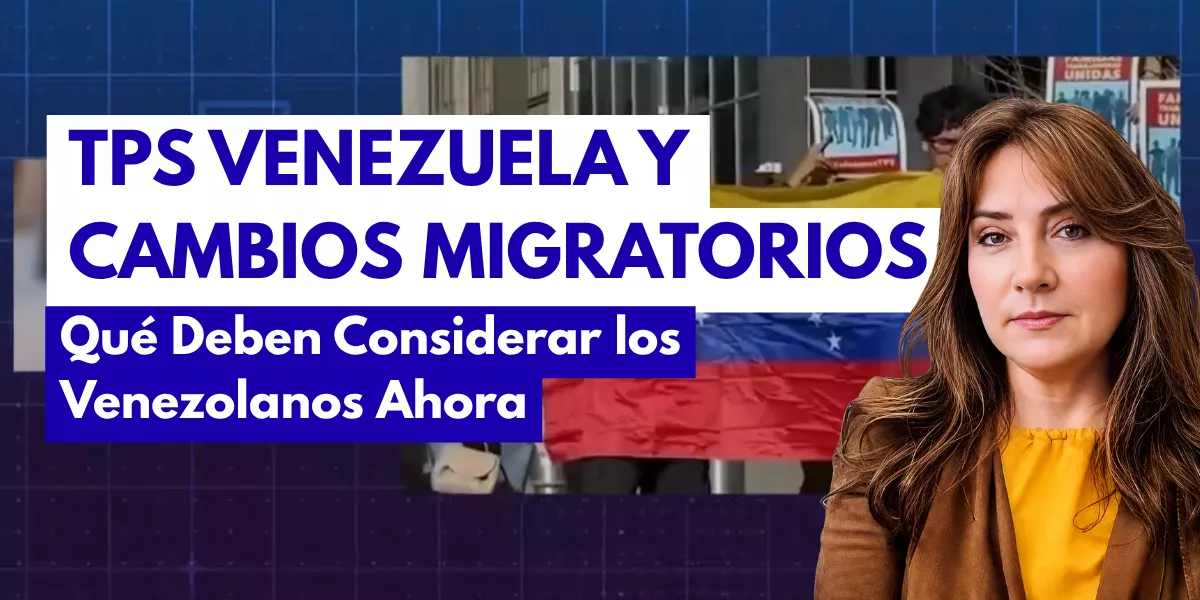
TPS for Honduras and Nicaragua Ends & Major Immigration Fee Increases

I had the opportunity to speak with Agustin Acosta about significant immigration news impacting thousands in our community.
First, the Department of Homeland Security has officially announced the end of Temporary Protected Status (TPS) for nationals from Honduras and Nicaragua. This decision affects around 72,000 Hondurans and 4,000 Nicaraguans currently living and working legally in the United States. Unless there’s a new legal challenge, these TPS protections will expire 60 days after publication in the Federal Register, leaving many in a difficult legal limbo.
We also discussed the uncertainty surrounding the automatic renewal of Venezuelan TPS and work permits, with key dates coming up in July and September. As of now, if no government action is taken, regulations call for a six-month automatic extension. However, with today’s ever-changing landscape, I expect new announcements soon.
Perhaps the most significant development is the signing of the new federal budget, known as the “Big Beautiful Bill.” This law brings the largest fee increases in decades for nearly all major immigration applications and processes, including asylum, TPS, work permits, and more. For example:
- Asylum application: $1,000 (plus $100 for every year pending over one year)
- Work permit through asylum: $550 for the initial application; $275 for renewals
- TPS application: $500 (up from $85)
- Humanitarian parole: $1,000
- Special Immigrant Juvenile (SIJ) application: $250
- Sponsor for SIJ: $3,500–$5,000
- Failure to attend immigration court: $5,000 fine
- Appeal to Board of Immigration Appeals: $900
- Green card application: $1,500 (previously $1,440)
- Waivers: $1,050 (previously $930)
- 5% tax on money sent abroad (remittances) starting January 2026
The new law also provides billions in additional funding for immigration enforcement, border infrastructure, and the hiring of 10,000 new ICE agents.
If you or your loved ones are affected by any of these changes, now is the time to consult with a qualified immigration attorney. Every case is different, and proper legal guidance is essential. If you have questions or need help, you can always reach me at (305) 671-0018
FOLLOW ME ON SOCIAL MEDIA
SPANISH TRANSCRIPT:
Agustin Acosta:
Gracias amigos por continuar en sintonía de Actualidad 1040 AM, 103.9 y 107.1 FM en el sur de la Florida, llegando a ustedes por tres diferentes frecuencias y por supuesto por nuestras redes sociales al resto del planeta. Carlos Acosta tiene el día libre hoy, así que me voy a quedar acá hasta las 7 y dentro de un ratito vamos a conversar también con Julio Bebione. Pero ahora vamos a hablar de inmigración, como siempre hacemos cada lunes a esta hora con la abogada Martha Arias. Doctora, muy buenas tardes.
Abogada Martha Arias:
Muy buenas tardes, Agustín. Un saludo para usted. Feliz comienzo de semana después de este fin de semana largo.
Agustin Acosta:
Claro que sí, doctora. Hay una noticia hoy que no es nada buena para hondureños y para nicaragüenses. Yo conozco particularmente el caso de un señor que vive, trabaja, se ha comportado impecablemente en cuanto a conducta acá en los Estados Unidos desde que llegó en 1998. Hasta ahora ha tenido una protección del TPS. Yo no sé si la protección que él particularmente tiene fue otorgada después del paso del huracán Mitch. Me parece que algunas personas de Centroamérica fueron beneficiadas por el paso de aquel huracán que dejó tantos miles de muertos. Hay otras personas que son nicaragüenses que también han tenido algún tipo de persecución política. La medida, según la información que aparece hoy publicada en la prensa americana, es que va a ser la suspensión del TPS para hondureños y nicaragüenses. Afectaría a 72,000 hondureños y 4,000 nicaragüenses. Cuéntenos un poco qué es lo que se sabe dentro del mundo donde usted se desenvuelve.
Abogada Martha Arias:
Sí, efectivamente, la secretaria del Departamento de Seguridad Nacional, señora Cristina Om, dijo el día de hoy, 7 de julio de este año 2025, que el TPS de Nicaragua y Honduras que va a expirar o que expiraría — ya expiró el 5 de julio — queda terminado y esto será efectivo 60 días después de la publicación en el registro federal. La publicación en el registro federal, pues me imagino que es hoy mismo, 7 de julio. Quiere decir que en 60 días, pues ya no tendrían este estatus legal. A no ser que haya, como sabemos que siempre aparece por ahí alguna demanda que ponga pausa a este TPS. Lo que aduce el Departamento de Seguridad Nacional es que el TPS no estaba supuesto a durar 25 años, que es lo que dicen ellos, un cuarto de siglo, y que ha durado esto, y esto fue a raíz, como usted dijo, del desastre natural que impactó a estos países en 1999. Ellos dicen que la razón de ese desastre natural, que fue lo que lo originó, ya no existe.
Agustin Acosta:
No hay ninguna forma, bajo la ley actual de inmigración, que esto se pueda convertir a una residencia, ¿verdad?
Abogada Martha Arias:
No. Las personas que tenían TPS y lograron, por ejemplo, muchos de mis clientes que lograron tener una residencia es porque viajaron, por ejemplo, con el TPS, volvieron a entrar y sus hijos o cónyuges ciudadanos americanos habían hecho alguna petición por ellos. Entonces, lograban ajustar el estatus a través de esa petición familiar y tal vez, pues, haciendo ese viaje, algunos que habían entrado tal vez ilegal antes de recibir el TPS.
Otros habían entrado con visa, pues lo podían hacer apenas sus hijos cumplían 21 años. Entonces, pues, la verdad, los pocos que queden con TPS que no hayan podido ajustar su estatus son personas que no tuvieron hijos o nunca se casaron con ciudadano americano y pues el TPS continuó siendo su única salvación migratoria. Ahora van a quedar en este limbo jurídico porque, de no existir una demanda que pause esta decisión, pues va a quedar terminado porque el gobierno sí lo puede terminar, obviamente.
Agustin Acosta:
Martha Arias, amigos, aprovecho en lo que vamos a tratar de recuperar la llamada, darles el teléfono de la doctora Arias por si alguno de ustedes necesita una buena representación legal o asesoría legal en materia de inmigración. Es el 305-671-0018. Ya la tenemos, doctora.
Abogada Martha Arias:
Sí, efectivamente, pues como le decía, es un procedimiento regular que estos TPS se aprueben o se terminen y el gobierno sí tiene la autoridad de hacerlo, previo seguimiento a la regulación, como en este caso es anunciarlo en el Registro Federal por 60 días antes. O sea, en otras palabras, se les da como un período de gracia de 60 días para las personas, para tomar su decisión de salir del país si no tienen otro remedio para permanecer.
Agustin Acosta:
Doctora, la última vez que conversamos, o tal vez la penúltima vez, usted nos hablaba del caso particular de los venezolanos que tenían un permiso de trabajo que expiraba en cierta fecha y usted nos dijo si el gobierno no interviene, viene una renovación automática. ¿De qué fecha estamos hablando específicamente y en qué estatus está eso?
Abogada Martha Arias:
La fecha es 12 de julio. Ya estamos acercándonos.
Agustin Acosta:
12 de julio. 12 ya es este fin de semana.
Abogada Martha Arias:
Correcto. O sea que para este fin de semana debemos estar esperando otra noticia sobre el TPS de Venezuela.
Agustin Acosta:
Si el gobierno no hace nada y esto se renueva, ¿se renueva por un año?
Abogada Martha Arias:
Seis meses, seis meses. Si el gobierno no dice nada, la regulación dice que automáticamente se renueva por seis meses y no creo que el gobierno de esta administración se vaya a quedar en silencio. Algo irán a decir.
Agustin Acosta:
Ok, este particular permiso de trabajo. ¿Cuándo es que se vencería, en septiembre?
Abogada Martha Arias:
En septiembre, el 9 de septiembre para algunos, el 6 de septiembre he visto también, otros se les vence el 6 de septiembre. Pero sí, definitivamente los primeros días de septiembre es que se vence este permiso de trabajo y el TPS de Venezuela.
Agustin Acosta:
O sea, si se renovara, entonces se renovaría hasta el mes de marzo del año entrante.
Abogada Martha Arias:
Correcto.
Agustin Acosta:
¿Alguna otra cosa que haya en este momento en vías judiciales, demandas, contrademandas, procesos de apelaciones que tenga una incidencia sobre inmigración?
Abogada Martha Arias:
Bueno, hay algo que me parece importante resaltar. Esto yo creo que sería una de las noticias más importantes del día de hoy lunes. Después de que el 4 de julio el presidente ya firmó como ley el “Big Beautiful Bill”, este bill sobre el presupuesto de los Estados Unidos.
¿Qué es lo que contiene esa ley para el tema migratorio? Varias cosas. La primera es un aumento de ciertas tarifas. Le voy a decir unas cuantas nomás, que me parecen las más importantes.
Las personas de ahora en adelante, y esto toma efecto el mismo día 4 de julio de este año, que es cuando el presidente lo firma. Así lo dice en la ley. O sea que desde el 4 de julio entra en vigencia.
Esto lo que pasa es que si migración nos va a tener que anunciar y pues si van a permitir que peticiones que nosotros ya habíamos enviado antes de que el bill fuera aprobado y que tal vez llegan esta semana nos van a dar ese período de gracia o si van a devolver esas peticiones.
Un ejemplo, peticiones de asilo que anteriormente no se cobraban, van a cobrar $1,000 dólares para las personas que apliquen para asilo, $1,000 dólares. Si el asilo continúa pendiente por más de un año, van a cobrar $100 dólares por cada año que el asilo esté pendiente. Entonces, si una persona tiene un asilo pendiente por 10 años, pues son 10 años pagando $100 dólares al año.
El permiso de trabajo por el asilo, el primer permiso de trabajo va a costar $550 dólares. Hoy en día el primer permiso de trabajo que se otorga a través del asilo no tiene costo, pero a partir del 4 de julio de este año 2025, va a costar $550 dólares. Y las renovaciones van a costar $275 dólares.
Agustin Acosta:
Las renovaciones son manuales.
Abogada Martha Arias:
En cada dos años, normalmente 18 meses, porque es lo que normalmente al TPS, 18 meses.
El TPS, hoy en día, se pagan $85 dólares, que es lo que cuestan las huellas. Van a cobrar $500 dólares para el TPS. No sé cuáles serán los TPS que van a sobrevivir, pero bueno, pusieron una tarifa de $500 dólares para el TPS y también $550 para la petición del permiso de trabajo inicial con TPS.
La persona que vaya a pedir un parol, por ejemplo, los cubanos que estaban entrando por la frontera, que nosotros les pedíamos los abogados el parol sea ante ICE y Miramar o el parol que pedíamos, por ejemplo, el de los militares, no tenía ningún costo, pero ahora este parol humanitario va a tener un costo de $1,000 dólares, también bastante alto.
Los niños, las aplicaciones para el Estatus Especial de Inmigrante Juvenil, que es la SIJ, que son los niños que entran sin compañía por la frontera, no tenían fee, ahora van a tener un fee de $250 dólares. Si alguien quiere patrocinar o ser el sponsor de un niño, va a tener que pagar de $3,500 a $5,000 dólares. Por ejemplo, ese niño entra por la frontera, hay un sponsor que está dispuesto a figurar como el sponsor de ese niño para que lo dejen entrar, pues va a tener que pagar ese dinero.
Esto que me pareció bien importante: la persona que falle o que no asista a una cita de la Corte de Inmigración le van a cobrar $5,000 por no asistir a esa cita de inmigración, bastante alto, como una multa.
Bueno, y hay otros aumentos de tarifas, por ejemplo, hoy en día, cuando la persona apela a la sala de apelaciones, normalmente la sala, por ejemplo, pierden un caso de asilo y van a apelar a la sala de apelaciones, que es el Board of Immigration Appeals. Hoy en día el fee era como 200 y algo, ciento y algo. Ahora va a quedar en $900 dólares.
Las peticiones de residencia, muy importante, antes costaban $1,440, subieron a $1,500 y los perdones a $1,050, estaban a $930. O sea que tuvo también un aumento grande. Repito, estas tarifas las van a publicar. Obviamente, esto apenas fue firmado el viernes. Sin embargo, el bill ya tiene las tarifas ahí escritas. La página de inmigración seguramente la van a actualizar pronto para que las personas sepan.
Una cosa final que le quiero decir de los aumentos de la tarifa, Agustín, es que las personas que envían dinero a sus países les van a subir un tax de 5% y este 5% opera a partir de enero de 2026. O sea que hay un tax por las remesas que vayan a enviar al extranjero a sus familiares.
Bueno, esto es un punto importante del bill que quería hablar. Le dije que quería decirle dos. Uno, pues era este aumento de las tarifas y el segundo, el aumento al presupuesto de inmigración. Se aumentó 45 billones para todo lo que sea detención, detention facilities, o todo lo que son los sitios donde se van a detener, van a tener un presupuesto adicional de 45 billones, billones con B de bueno.
46 billones con B de bueno para soportar todo lo que es la infraestructura y afianzar la frontera, o sea, todo lo que es “Support the Border” y la infraestructura de la frontera, 46 billones con B y 14 billones de dólares para lo que yo llamé el “Year Mark for Deportation”. Year Mark quiere decir como lo que es la logística, cómo van a determinar cómo se van a hacer las deportaciones y todo, porque como habíamos dicho incluso aquí en Actualidad Radio anteriormente, la logística de las deportaciones es algo…
Agustin Acosta:
Que contratar aviones, pagar la gasolina, los pilotos, los permisos de aterrizaje. Y no saber…
Abogada Martha Arias:
Y saber dónde van porque no es que van a ir a la Zara a ver a quién se encuentran por ahí en la calle para deportar. Esas son deportaciones que también van a estar obviamente pensadas, planeadas, saber dónde van a llegar, qué es la persona que van a acoger. Para esto hay un fondo especial para contratar 10,000 más agentes de ICE.
Entonces, el bill que fue firmado por el presidente, el “Big Beautiful Bill”, que ahora es una ley, pues tiene estas dos cosas importantes para la inmigración: aumento en el presupuesto para todo lo que es la parte migratoria y el aumento de las tarifas. Agustín, eso me parece importante decirlo hoy lunes, esto fue firmado el viernes, todavía la gente estaba en su efecto de descanso del fin de semana, pero bueno, hoy nos recibe esta noticia también importante para los oyentes.
Agustin Acosta:
Desde que comenzó el proceso en enero, ¿usted ha visto en su oficina algún aumento de lo que son certificaciones laborales, o sea, personas que han estado acá con el parol o con el TPS o con alguna otra figura migratoria?
Abogada Martha Arias:
Sí he visto más consultas. Sí.
Agustin Acosta:
Pero el tema de las certificaciones laborales, ¿es una cuesta arriba o es realmente algo que pudiera ser un canal para algunas personas optar por su normalización?
Abogada Martha Arias:
Para algunas personas sí puede ser un canal, es una opción. Lo que pasa es que no aplica para todos, porque fíjese, yo siempre le digo a la gente que hay tareas que, por ejemplo, de bajo perfil, que son personas que no necesitan mucha educación y experiencia, pero que sí, aunque sean de bajo perfil, nadie quiere hacer ese trabajo. Por ejemplo, los trabajos de la agricultura. Son trabajos donde, pues, no hay entrenamiento, no necesita mucho estudio, pero nadie se quiere aguantar diez horas en el sol de la Florida con la humedad, con los mosquitos, cogiendo los tomates o las cosechas.
Entonces, ese tipo de persona, aunque es de bajo perfil, puede, tal vez, si tiene una oferta de trabajo y todo, lograr un beneficio. Mientras que, o el profesional calificado que tiene maestrías, el ingeniero o el médico, esa persona que tiene una experiencia y está calificado. Yo pienso que los trabajos que quedan como en la mitad. Por ejemplo, un trabajo que es muy típico, un abogado de otra parte, un abogado aquí necesita la licencia para trabajar y aunque esté trabajando para otro abogado haciendo cierto tipo de labor, a veces es muy difícil conseguirle lograr una certificación laboral a no ser que esté en un nicho específico de la ley. Y hay ciertas ocupaciones así, entonces depende del caso, depende de la persona.
También depende del tiempo que la persona lleva aquí en los Estados Unidos y si estuvo ilegal o no. Yo he tenido personas que vienen a mi oficina y, por ejemplo, nunca aplicaron para asilo y aplicaron para el TPS después de que salió, pero después de dos o tres años de estar sin estatus.
A esa persona yo le digo, la verdad, no vale la pena que haga una certificación laboral porque, así le aprueben la certificación laboral y le aprueben la I-140, que es la petición que se hace ante inmigración después de que le aprueban esa certificación laboral, si la persona no va a poder recibir la residencia aquí dentro del país, va a tener que salir. Pero como completó más de un año ilegal, va a estar sujeto a una penalidad de 10 años que no puede entrar.
Entonces, se van a gastar un montón de plata en esa certificación laboral y en la I-140, que estamos hablando de más de $15,000 dólares entre abogados y fees, ¿para qué? Para llegar a un punto muerto y tener que llegar a nada porque se van a tener que ir 10 años afuera y qué empleador los va a esperar 10 años.
Entonces, eso le digo yo, pero hay gente inocente que cae en manos no muy honestas, donde no les explican y les hacen, claro, venga yo le hago ese paso, dos pasos, pero sabe que van a llegar a un punto muerto y cuando llegan al punto muerto le dicen, ah, qué pena, mire. Entonces, eso, yo siempre le digo a la gente, pregunte bien, porque no todo el mundo va a poder sacar una certificación laboral. Y aunque la saque y la logre, no va a ser posible recibir la residencia.
Agustin Acosta:
Sí, por la ilegalidad, ¿no? Porque el trámite conlleva salir y tomar la residencia desde fuera en un consulado o embajada, pero la ilegalidad entonces le garantiza un periodo de castigo.
Abogada Martha Arias:
Correcto. Pero hay gente que no tiene el castigo porque estuvo o en un asilo o con el TPS o estuvo en un estatus que lo protegió de acumular esa presencia ilegal, que es lo que sanciona la ley, la presencia ilegal.
Entonces, cada caso por eso se debe analizar. Yo tengo, por ejemplo, venezolanos, tengo varios muy calificados, personas venezolanas que están trabajando para compañías muy reputables, con una experiencia buenísima, que están dispuestos a hacer ese proceso, pero tienen que salir del país, pero nunca acumularon presencia ilegal porque tenían asilo y después TPS, entonces siempre se protegieron de no acumular presencia ilegal.
Esas personas pueden salir, pero hay otras que no. Entonces, esos son los análisis que las personas tienen que hacer antes de embarcarse en un proceso tan costoso como ese.
Agustin Acosta:
Muy bien. Doctora, muchísimas gracias. Déjeme volver a reiterar su número telefónico. Es el 305-671-0018. 305-671-0018. Martha Arias, abogada de inmigración, también está en Facebook con su nombre y apellido Martha Arias, pero su nombre con versión M-a-R-T-H-a por Facebook Martha Arias o directamente al bufete por el (305) 671-0018. Muchísimas gracias.
Abogada Martha Arias:
Gracias a ustedes. Feliz resto de semana.
Agustín Acosta:
Igualmente.
ENGLISH TRANSCRIPT:
Agustin Acosta:
Thank you, friends, for staying tuned to Actualidad 1040 AM, 103.9, and 107.1 FM in South Florida, reaching you through three different frequencies and of course through our social networks to the rest of the planet. Carlos Acosta has the day off today, so I’ll be here until 7, and in a little while we’ll also talk with Julio Bebione. But now we’re going to talk about immigration, as we do every Monday at this hour with attorney Martha Arias. Attorney, good afternoon.
Attorney Martha Arias:
Good afternoon, Agustin. Greetings to you. Happy start to the week after this long weekend.
Agustin Acosta:
Of course, attorney. There is news today that is not good at all for Hondurans and Nicaraguans. I know particularly the case of a gentleman who lives, works, and has behaved impeccably regarding conduct here in the United States since he arrived in 1998. Until now he has had TPS protection. I don’t know if the protection he particularly has was granted after Hurricane Mitch. It seems to me that some people from Central America were benefited because of that hurricane that left so many thousands dead. There are other people who are Nicaraguans who have also suffered some type of political persecution. The measure, according to the information published today in the American press, is that TPS for Hondurans and Nicaraguans will be suspended. It would affect 72,000 Hondurans and 4,000 Nicaraguans. Tell us a bit about what is known within the world in which you work.
Attorney Martha Arias:
Yes, indeed, the Secretary of the Department of Homeland Security, Mrs. Kristi Noem, said today, July 7, this year 2025, that TPS for Nicaragua and Honduras, which will expire or would have expired — already expired July 5 — is ended and this will be effective 60 days after the publication in the Federal Register. The publication in the Federal Register, I imagine, is today, July 7. That means in 60 days, they would no longer have this legal status. Unless, as we know always seems to appear, there is a lawsuit that pauses this TPS. What the Department of Homeland Security argues is that TPS was not supposed to last 25 years, which is what they say, a quarter of a century, and that it has lasted this long, and this was due, as you said, to the natural disaster that impacted these countries in 1999. They say that the reason for that natural disaster, which was the origin, no longer exists.
Agustin Acosta:
There is no way, under current immigration law, that this could be converted to a green card, correct?
Attorney Martha Arias:
No. People who had TPS and managed, for example, many of my clients who managed to get residency, it was because they traveled, for example, with TPS, re-entered, and their children or American citizen spouses had filed petitions for them. So, they managed to adjust status through that family petition and perhaps, by making that trip, some who had maybe entered illegally before receiving TPS.
Others had entered with a visa, so they could do it as soon as their children turned 21. So, truly, the few who remain with TPS and haven’t been able to adjust their status are people who didn’t have children or never married an American citizen, and so TPS continued being their only migratory salvation. Now they will be left in this legal limbo because, unless there is a lawsuit that pauses this decision, it will be ended, because the government can, obviously, end it.
Agustin Acosta:
Martha Arias, friends, I’ll take the opportunity as we try to recover the call to give you the phone number of attorney Arias in case any of you need good legal representation or legal advice on immigration matters. It’s (305) 671-0018. We have her back, attorney.
Attorney Martha Arias:
Yes, indeed, as I was saying, it’s a regular procedure for these TPS to be approved or ended, and the government does have the authority to do so, following regulation, as in this case, announcing it in the Federal Register 60 days before. So, in other words, people are given a 60-day grace period to decide to leave the country if they have no other remedy to remain.
Agustin Acosta:
Attorney, the last time we talked, or maybe the time before last, you spoke to us about the particular case of Venezuelans who had a work permit expiring on a certain date, and you told us if the government doesn’t intervene, there is an automatic renewal. What specific date are we talking about and what is the status of that?
Attorney Martha Arias:
The date is July 12. We’re getting close.
Agustin Acosta:
July 12. 12 is already this weekend.
Attorney Martha Arias:
Correct. So, for this weekend, we should be expecting other news about TPS for Venezuela.
Agustin Acosta:
If the government does nothing and this renews, does it renew for a year?
Attorney Martha Arias:
Six months, six months. If the government says nothing, the regulation says it’s automatically renewed for six months, and I don’t think this administration’s government will remain silent. They’ll say something.
Agustin Acosta:
Ok, this particular work permit. When does it expire, in September?
Attorney Martha Arias:
In September, September 9 for some, September 6 for others, I’ve seen. But yes, definitely the first days of September is when this work permit and TPS for Venezuela expire.
Agustin Acosta:
So, if renewed, it would be renewed until March of next year.
Attorney Martha Arias:
Correct.
Agustin Acosta:
Is there anything else at this time in the courts, lawsuits, counter-lawsuits, appeals processes that have an impact on immigration?
Attorney Martha Arias:
Well, there’s something I think is important to highlight. I think this would be one of the most important news items today, Monday. After July 4, the president signed into law the “Big Beautiful Bill,” this bill on the U.S. budget.
What does that law contain for the immigration issue? Several things. The first is an increase in certain fees. I’ll mention just a few, which seem most important to me. From now on, and this takes effect on July 4 of this year, which is when the president signed it. That’s what the law says. So, from July 4, it’s in effect. The thing is that immigration will have to announce if they will allow petitions we already sent before the bill was approved and that maybe arrive this week, whether they’ll give us that grace period or return those petitions.
An example: asylum petitions that previously were not charged a fee will now cost $1,000 for people who apply for asylum, $1,000. If the asylum remains pending for more than a year, they will charge $100 for each year the asylum is pending. So, if a person has an asylum pending for 10 years, it’s 10 years paying $100 per year.
The work permit for asylum, the first work permit, will cost $550. Today, the first work permit through asylum is free, but as of July 4, 2025, it will cost $550. Renewals will cost $275.
Agustin Acosta:
Renewals are manual.
Attorney Martha Arias:
Every two years, normally 18 months, because normally TPS is 18 months. TPS, today, costs $85, which is the fingerprint fee. They will now charge $500 for TPS. I don’t know which TPS will survive, but anyway, they set a fee of $500 for TPS and also $550 for the initial work permit request with TPS. People who want to request parole, for example, Cubans who were entering at the border, we lawyers used to request parole at ICE in Miramar or, for example, parole for the military, had no cost, but now this humanitarian parole will cost $1,000, also quite high.
Children, applications for Special Immigrant Juvenile Status, SIJ, which are children who enter unaccompanied at the border, had no fee, now will have a fee of $250. If someone wants to sponsor a child, they will have to pay from $3,500 to $5,000. For example, that child enters at the border, there’s a sponsor willing to be the sponsor so the child is let in, they will have to pay that money. This, which seemed very important to me: the person who fails to attend or doesn’t show up to an Immigration Court appointment will be charged $5,000 for not attending that immigration appointment, quite high, as a fine.
Well, and there are other fee increases, for example, today, when someone appeals to the appeals board, for example, loses an asylum case and appeals to the appeals board, which is the Board of Immigration Appeals. Today the fee was like two hundred something, one hundred something. Now it will be $900.
Green card petitions, very important, used to cost $1,440, now $1,500 and waivers $1,050, they were at $930. So, another large increase. I repeat, these fees will be published. Obviously, this was just signed Friday. However, the bill already has the fees written in. The immigration website will surely be updated soon so people know.
One last thing about fee increases, Agustin, people who send money to their countries will have a 5% tax and this 5% operates starting January 2026. So there is a tax for remittances sent abroad to family. Well, that is an important point from the bill I wanted to talk about. I told you I wanted to mention two things.
One was this fee increase, and the second, the immigration budget increase. There was a $45 billion increase for everything detention-related, detention facilities, all the places where people are detained, will have an additional $45 billion budget, billion with a B as in “boy.” $46 billion with a B for supporting all the infrastructure and reinforcing the border, everything that is “Support the Border” and border infrastructure, $46 billion with a B, and $14 billion for what I called the “Earmark for Deportation.” Earmark means the logistics, how they’ll determine how deportations are done, and all that, because as we had said here on Actualidad Radio previously, the logistics of deportations is something…
Agustin Acosta:
That means hiring planes, paying for gas, pilots, landing permits. And not knowing…
Attorney Martha Arias:
And knowing where they’re going because it’s not like they’ll just go out in the street to see who they run into to deport. Those deportations will also be, obviously, thought out, planned, knowing where they’ll arrive, who they’ll pick up. For this there is a special fund to hire 10,000 more ICE agents.
So, the bill signed by the president, the “Big Beautiful Bill,” which is now law, has these two important things for immigration: increase in the immigration budget and fee increases. Agustin, I think it’s important to say this today, Monday, this was signed Friday, people were still resting from the weekend, but today we have this important news for listeners.
Agustin Acosta:
Since the process started in January, have you seen in your office any increase in labor certifications, that is, people who have been here with parole, TPS, or some other migratory figure?
Attorney Martha Arias:
I have seen more consultations, yes.
Agustin Acosta:
But the issue of labor certifications, is it an uphill struggle or is it truly something that could be a channel for some people to seek regularization?
Attorney Martha Arias:
For some people it could be a channel, it’s an option. But it doesn’t apply to everyone, because, see, I always tell people that there are tasks, for example, low-skill, which are people who don’t need much education or experience, but yes, even if low-skill, nobody wants to do that work. For example, agricultural work. Jobs where there’s no training, not much study needed, but nobody wants to put up with ten hours in the Florida sun, with humidity, mosquitoes, picking tomatoes or crops. So, that type of person, even though it’s low-skill, can maybe, if they have a job offer and all, obtain a benefit. While, or the highly qualified professional who has a master’s, engineer, or doctor, that person who has experience and is qualified. I think the jobs that are in the middle.
For example, a very typical job, a lawyer from another country, a lawyer here needs a license to work and even if working for another lawyer doing certain work, sometimes it’s very hard to get them a labor certification unless they are in a very specific legal niche. And there are certain occupations like that, so it depends on the case, the person. Also depends on how long the person has been in the U.S. and if they were illegal or not. I’ve had people come to my office who, for example, never applied for asylum and applied for TPS after it came out, but after two or three years of being without status. To that person I say, honestly, it’s not worth it to get a labor certification, because even if they approve it and approve the I-140, which is the petition made to immigration after they approve that labor certification, if the person cannot get their green card here, they’ll have to leave. But since they were over a year illegal, they’ll be subject to a penalty of 10 years not being able to enter.
So, they’ll spend a lot of money on that labor certification and on the I-140, which we’re talking about more than $15,000 between lawyers and fees, for what? To reach a dead end and have to leave for 10 years and what employer will wait 10 years. So, I tell them, but there are innocent people who fall into not very honest hands, where they don’t explain and just say, sure, I’ll do those steps, but they know you’ll reach a dead end, and when you get to the dead end they say, oh, sorry, look. So that’s why I always tell people, ask well, because not everyone can get a labor certification. And even if they get it, it’s not always possible to get a green card.
Agustin Acosta:
Yes, because of illegality, right? Because the process involves leaving and getting the green card abroad at a consulate or embassy, but the illegality then guarantees a punishment period.
Attorney Martha Arias:
Correct. But there are people who don’t have the punishment because they were in asylum or with TPS or in a status that protected them from accumulating unlawful presence, which is what the law punishes, unlawful presence.
So, each case must be analyzed. I have, for example, Venezuelans, I have several highly qualified Venezuelans working for very reputable companies, with great experience, who are willing to do this process, but they have to leave the country, but never accumulated unlawful presence because they had asylum and then TPS, so they always protected themselves from accumulating unlawful presence. Those people can leave, but others cannot. So, those are the analyses people must make before embarking on such a costly process.
Agustín Acosta:
Very good. Attorney, thank you very much. Let me repeat your phone number. It’s (305) 671-0018. Martha Arias, immigration attorney, is also on Facebook with her name and surname, Martha Arias, but her name spelled M-A-R-T-H-A on Facebook as Martha Arias or directly at her office at (305) 671-0018. Thank you very much.
Attorney Martha Arias:
Thank you all. Have a great rest of your week.
Agustín Acosta:
Same to you.